
The Treasure Ships
Will China build the world's factories or simply buy the world's cities?

The Black Hole
There is a country where the state owns all the land. Every square metre beneath every tower in every city belongs, in the last analysis, to the public. No private freeholder holds the ground under the flats. By the oldest argument in political economy, the line that runs from Smith and Ricardo down to Henry George, this country should have been spared the disease that quietly organises every other. The disease is rent, the tribute that flows to whoever owns a scarce location, levied on everyone who has to stand on it. Take the land into public hands, George’s followers said for the better part of a century, and you drain the pond in which rent breeds.
China did precisely what they asked. It kept the land. Then it assembled one of the largest property booms in the history of the world, and is now living through the bust.
The figures are those of a textbook unwinding. By the middle of 2026, new-build prices across seventy cities had fallen year on year for thirty-five months without a single break. Property investment was down about sixteen per cent on the year. The six largest banks had watched their mortgage books shrink three years running as households, rather than borrow, quietly repaid what they owed. Land sales, once the single richest vein of local government money, had roughly halved from their peak. New bank lending had dropped to its lowest since 2018. None of this is the signature of a market that ran too hot for a season. It is the signature of a structure coming down.
You might stop me here and say this is simply demography. China is ageing, and its total population has been shrinking since 2022, so surely fewer people means fewer flats and softer prices. The demography is real. But look at where the fall actually landed, and the simple story comes apart. Even as the country as a whole began to contract, its cities went on filling. Urbanisation continued, the urban share of the population kept rising, and the tier-one cities remained the most sought-after addresses in the country, their flats rationed by lottery and residence test. Beijing, which turns away far more people than it admits, saw its prices fall regardless. Shanghai, still drawing people in, saw its prices hold while most of the country slid. Same demographic wind, opposite outcomes, which is exactly what you get when it is the scarcity of the location, and not the size of the national population, that sets the price. And the timing gives the rest away. The decline did not steal in slowly as a generation aged. It arrived sharply, in cities that were still growing, once the authorities had set out, quite deliberately, to let the air out of the boom. That is not what a demographic bust looks like. Demography steepened the ground the whole thing stood on. It did not stack the structure, and it did not push it over.
So the question almost asks itself. How does a state that owns all of its land end up with a rentier black hole at the centre of its economy? If ownership were the thing that mattered, public ownership should have settled it. It did not settle it, which tells you that ownership was never the operative variable. Something else was doing the work, and it was doing it in plain sight.
Consider where a Chinese household could actually put its savings. It could hold deposits at the bank, at interest rates that rarely kept pace with the cost of the thing it was saving for. It could buy domestic shares, in a market with a long reputation for parting the retail investor from his money. It could purchase various managed products of uncertain quality. What it could not do, and still cannot, is move its money freely across the border into the wider world of foreign shares, foreign bonds and foreign property. The annual quota for taking money out sits at fifty thousand dollars a person, and even that may not lawfully be spent on property or securities abroad. The border was, and remains, closed to the ordinary saver.
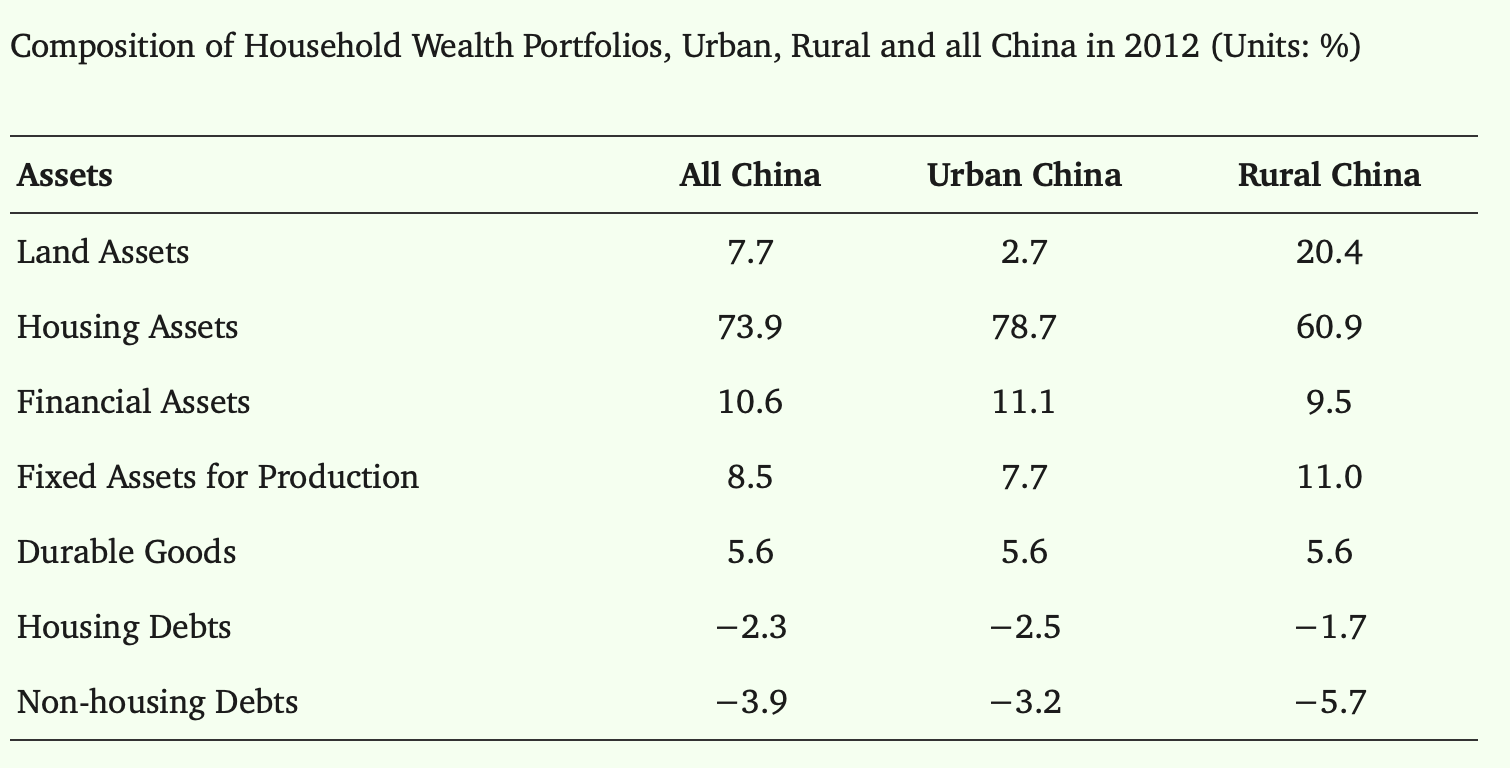
Inside that closed system, one asset behaved differently from all the others. Property could be borrowed against. It had appreciated, reliably, for a generation. It was bound up with the things a life is measured by, a marriage, a family, a school place, a claim that could be passed to a child. It was visible in a way a brokerage balance is not. So the savings of a nation, denied the exits, found the one destination that seemed to reward them, and poured in. This is the black hole. Not a figure of speech for collapse, but for concentration, a region of the economy whose pull on capital grew so strong that, once money crossed the threshold, very little of it ever came back out. With a closed door to the rest of the world and limited domestic options, the household wealth concentration into property is a global anomaly at approximately 74% of household wealth.
In Beijing, Shanghai and Shenzhen the flat stopped being somewhere to live and became the measure of whether you were winning. It was the benchmark against which a young worker judged their own progress, and increasingly the benchmark receded faster than they could advance towards it. Hold that thought, because the behaviour it produces will matter later. For now the question is why the reference asset behaved the way it did, and answering it means taking the black hole apart. It has three moving parts.
The first is the one everyone can see and almost nobody believes. You cannot build your way out. China’s response to expensive property was to build property on a scale without precedent in human history, and the black hole survived the attempt, because a flat in an overbuilt city in the interior is not a substitute for a flat that comes with access to Shanghai’s labour market. You can lay another million foundations. You cannot lay down another Shanghai. Economists call this a low elasticity of supply, and the phrase rather flatters how strange the thing is. A careful study of thirty-five Chinese cities by Li and Malpezzi put numbers to it, in the coastal tier-one cities, Shanghai, Shenzhen, Qingdao, supply barely responds to price at all, while in the interior it responds almost without limit. Build a tower in the interior and the price gives way. Build a tower in Shanghai and the location absorbs it and asks for more.
There is a quieter piece of evidence, and it is the more telling for being a confession. The tier-one cities are precisely the ones that ration who is allowed to buy. They bar purchases by people without local residence. They cap the number of homes a family may hold. They impose waiting periods and residence tests. A government reaches for demand rationing only when it has given up on supply. If you could build enough, you would let people buy, you ration the buyers because you cannot build the thing they are trying to buy. The purchase restriction is the state conceding, in the dry language of policy, that the location cannot be manufactured.
The second part is the machinery that bolts the flat to the banking system. A Chinese buyer puts down as little as fifteen per cent and borrows the rest, on a loan that can run thirty years and whose rate is not fixed but reset periodically against a benchmark that moves with policy. The asset and the credit are welded together. When the location rises in value it becomes collateral for more borrowing, which becomes demand for more location, which lifts the value again. When it falls, the same machine runs in reverse. By 2025 the average household carried debt worth close to a hundred and forty per cent of its disposable income, most of it secured against the very asset whose price was by then sliding. That is not a market with a lot of leverage in it. That is a market that is leverage, wearing the costume of a home.
The third part is the one that turns the paradox inside out, and it lives in the tax code, or rather in the space where a tax ought to be. In most countries the state that plays host to a property boom at least taxes it as it runs, taking a slice of the value every year through a recurring property tax. China does not have one, not at any scale that matters. Two pilot schemes have run in Shanghai and Chongqing since 2011, and between them they raise tax equal to about three per cent of local tax revenue, which is to say they are symbolic. The plan to take a property tax nationwide has been announced, deferred and shelved more than once. Instead, local governments raise their money by selling the use of land outright, in a single lump, for seventy years at a time. And this is where the ownership everyone points to stops protecting anyone and quietly begins to do the opposite.
Think about what that arrangement does to the incentives of the owner. A landlord who is paid once, at the moment of sale, does not profit from land being useful. He profits from land being expensive. Having sold the seventy-year right, the local government’s revenue no longer depends on the productive life of the site but on the next sale, and the one after that, each of which it needs to come in richer than the last. The state that owns all of the land has arranged its own finances so that it, too, requires the price to keep climbing. The public landlord and the speculator are no longer on opposite sides of the table. They want the same thing.
Selling the land once and taking the proceeds is, on the face of it, exactly what a Georgist would want, the public captures the land value, rather than a private owner pocketing it. But a single sale can only capture what the land is expected to be worth on the day it is sold. It cannot capture what the land turns out to be worth after four decades of the fastest sustained growth any large economy has ever recorded. The price struck at auction was set against the expectations of that moment. The rent the location went on to throw off ran far ahead of those expectations, and every yuan of the difference accrued not to the state that had sold the right, but to the private holder who happened to be sitting on it, and who could now borrow against it. The state captured the land value once, and cheaply, and then watched the miracle it had done so much to create flow straight past it into private hands. The country that owned all the land had, through the design of its own tax system, sold itself out of the upside. That is the inversion. It is why public ownership did not save it, and it is where the black hole was always going to form.
Return, now, to the young worker measuring their life against the reference. Below a benchmark that keeps receding, a person has three moves. They can work harder and try to close the gap, although the gap has a habit of widening faster than wages. They can take a large risk in the hope of clearing it in a single bound, which is a polite description of a good deal of speculative behaviour. Or they can stop playing, and the phenomenon the Chinese internet calls tang ping, lying flat, the quiet refusal to keep competing for a prize that has floated out of reach, is at the very least consistent with a cohort that has done the arithmetic. All three responses are precisely what the theory predicts when the reference asset climbs beyond the reach of the people measuring themselves against it.
The state’s ownership of the land was never a defence against the rentier black hole. It was, through the accident of how that ownership was monetised, the very thing that guaranteed one. A socialist state, having taken all the land into public hands, built a fiscal system that gave the public landlord a private landlord’s appetite for a rising price, and then presided over exactly the boom that appetite demands. The remarkable thing is not that the bubble formed. The remarkable thing is that it formed in the one country that, on paper, had already solved the problem.
Which leaves the more interesting question. What does such a state do when it finally looks at the machine it has built, and decides to switch it off?
Pulling the Plug
Every part of the machine described so far was behaving ‘rationally’. The household that stretched to buy a flat in Shanghai was not being reckless; it was putting its savings into the one asset the system reliably rewarded. The developer that borrowed to the hilt to buy land was not being greedy; it was responding to a market in which land had risen every year anyone could remember. The bank that lent against that land was not being careless; the collateral was appreciating and the state stood behind the whole edifice. The local government that sold the land, dearer each year, was not being cynical; it was paying for schools and roads out of the only revenue base it had been handed. Each player, looked at on its own, was doing the sensible thing. The trouble was what the sensible things added up to.
Put them together and you get a loop. Capital buys land. Land becomes collateral. Collateral supports credit. Credit chases land, which rises, which supports more credit, which chases more land. Round it goes, and with every turn a little more of the nation’s savings is drawn out of everything else and into the same widening well. By the end, an economy that told the world it meant to build the future in solar panels and semiconductors was sinking an extraordinary share of its capital into the ground beneath its own cities. Nobody chose this, It was the sum of a billion rational decisions.
You do not need to credit anyone with a theory to see what happened next. The state did not have to read Henry George to notice that a rising share of the national resource was disappearing into an increasingly leveraged machine, and that the machine stayed upright only so long as the borrowing and the prices both kept climbing. That is a fragile way for a large economy to hold itself together. In 2020, the authorities moved to change it.
The instrument was a set of limits on how much a property developer could borrow, measured against its assets, its equity and its cash. The rules were known, with the bluntness the Chinese state sometimes favours, as the three red lines. A developer that breached all three could take on no further debt at all. On paper it was a piece of prudential housekeeping. In effect it was a decision to reach into the engine and turn off the fuel.
To see why that was enough, borrow an idea from Hyman Minsky. Some borrowers expect to repay their debts out of income. Others expect only to service the interest and roll the principal over, again and again, so that the debt is never really repaid, merely refinanced in perpetuity. A structure of the second kind works beautifully while the money keeps moving. It has a single requirement, that the refinancing never stops. The large Chinese developer, by 2020, was in many cases the pure case of this, funding today’s obligations with tomorrow’s pre-sales and next year’s loan, never expecting to clear the balance so much as to keep it rolling. The three red lines removed the one thing such a structure cannot do without. The moment fresh borrowing was capped, the developers that had been rolling their debts could no longer roll them.
The company that became the emblem of this was Evergrande, at the time the most indebted property developer on earth, carrying liabilities past three hundred billion dollars. Denied new credit, it could not meet the obligations that only new credit had ever met. It defaulted. A Hong Kong court ordered its liquidation at the start of 2024, and in the summer of 2025 its shares were struck off the exchange for good, after eighteen months suspended, with more than forty-five billion dollars of creditor claims lodged against a carcass whose assets sat, largely stranded, back on the mainland. It is tempting to cast Evergrande as the villain of the piece, the reckless borrower who brought the house down. That is precisely the wrong reading. Evergrande did nothing the logic of the system had not been rewarding for twenty years. It was not the disease, It was the most advanced case of it.
There is a part of the Evergrande story the liquidation figures miss, and it is the part that matters most for what followed, not what the company owed, but what its buyers had thought they were buying. For the household standing below the reference, the pre-sold flat was never only a home. It was the closest thing the walled economy offered to a lottery ticket. A buyer put down a deposit of between ten and thirty per cent on an apartment not yet built, in a tower not yet standing, discounted below the going price by a developer almost everyone assumed the state would never permit to fail. China is a recourse market, so the loss was never truly capped, if the project collapsed, the buyer still owed the bank. But behaviourally the downside was believed away, held off by the near-certainty of official rescue, while the upside ran on leverage. A ten percent deposit is a tenfold gearing, so a market that rose ten percent in a year, as this one reliably had, could double the buyer’s initial equity. A relatively small ticket, levered upside, and a downside the state was assumed to have quietly underwritten. In an airless investment universe it looked enough like a lottery ticket to draw the whole below-reference cohort in, and when the developers fell it did not merely strand a balance sheet. It closed the lottery.
Beside that flat sat a second instrument, sold on the very same assumption. Trust firms and shadow banks packaged high-yielding wealth management products and offered them to the comfortable saver as though the return were as safe as a bank deposit and just as quietly guaranteed by the state. The money they raised was funnelled, in large part, straight back into the property complex, to the developers and local vehicles the banks would no longer lend to directly. When property turned, the products turned with it. The largest of these houses, Zhongzhi, collapsed into insolvency owing sixty four billion dollars against less than half that in assets, and roughly a hundred and fifty thousand of the country’s better-off savers discovered in a single afternoon that the guarantee they had assumed protected them had never once been written down.
Here the Chinese episode parts company with the one every Western reader has in mind. In 2008 a comparable structure came apart on its own, at speed, and the unwinding fed on itself: forced sales drove prices down, which forced more sales, which broke the banks that had lent against the collateral. A Minsky moment, then a fire sale, then a financial heart attack, all inside a single autumn.
China’s version has not gone that way, and the reason is that this reversal was triggered from above, on purpose, by a state with unusual power over the pace of what came after. There was no single day of panic. There has been, instead, a long and managed deflation. Developers have been allowed to fail, but slowly. Prices have been allowed to fall, but by degrees. The banks, mostly state-owned, have been leaned on to stay standing. What in 2008 took months has in China been drawn out over years, which is why the West kept waiting for a crash that never quite arrived in the shape it expected.
What arrived instead was quieter, and in its way more revealing. Households stopped treating property as the thing to pour money into and began, in very large numbers, doing the opposite, repaying their mortgages ahead of schedule, to be rid of the debt. The mortgage books of the biggest banks have shrunk three years running. New lending across the whole system fell in 2025 to its lowest in seven years. This is what economists, after studying Japan’s long slump, call a balance-sheet recession: a whole population quietly deciding, at more or less the same time, that the priority is no longer to acquire assets but to pay down debt. It is not a panic, It is something slower and much harder to reverse, a collective change of mind about what money is for.
On its own terms, and set against the argument of the first part, what the state did was broadly right. It had a machine drawing the nation’s capital into unproductive scarcity, and it deliberately cut that machine’s capacity to keep doing so. If the black hole was the problem, shrinking its pull was a sane response. Very few governments manage to move against a bubble on purpose while it is still inflating, because the political pressure runs entirely the other way, the people who own the asset are the people who vote, and they do not thank you for ending the party. That the Chinese state could do it at all is a measure of how much less constrained it is than most.
But it made one mistake, It closed the old savings vehicle before it had built a new one, and closed the only lottery left on-shore, and left the door open to just one.
For a generation, property had been the place the nation’s savings went. It was the store of value, the collateral, the pension, the inheritance, the visible proof of a life’s work. When the state throttled it, it did not open an alternative of anything like comparable size. The border stayed shut: an ordinary saver may still take only fifty thousand dollars a year out of the country, and may not lawfully spend even that on property or shares abroad. The domestic stock market commanded little trust. So the savings did the only thing left to them. They sat.
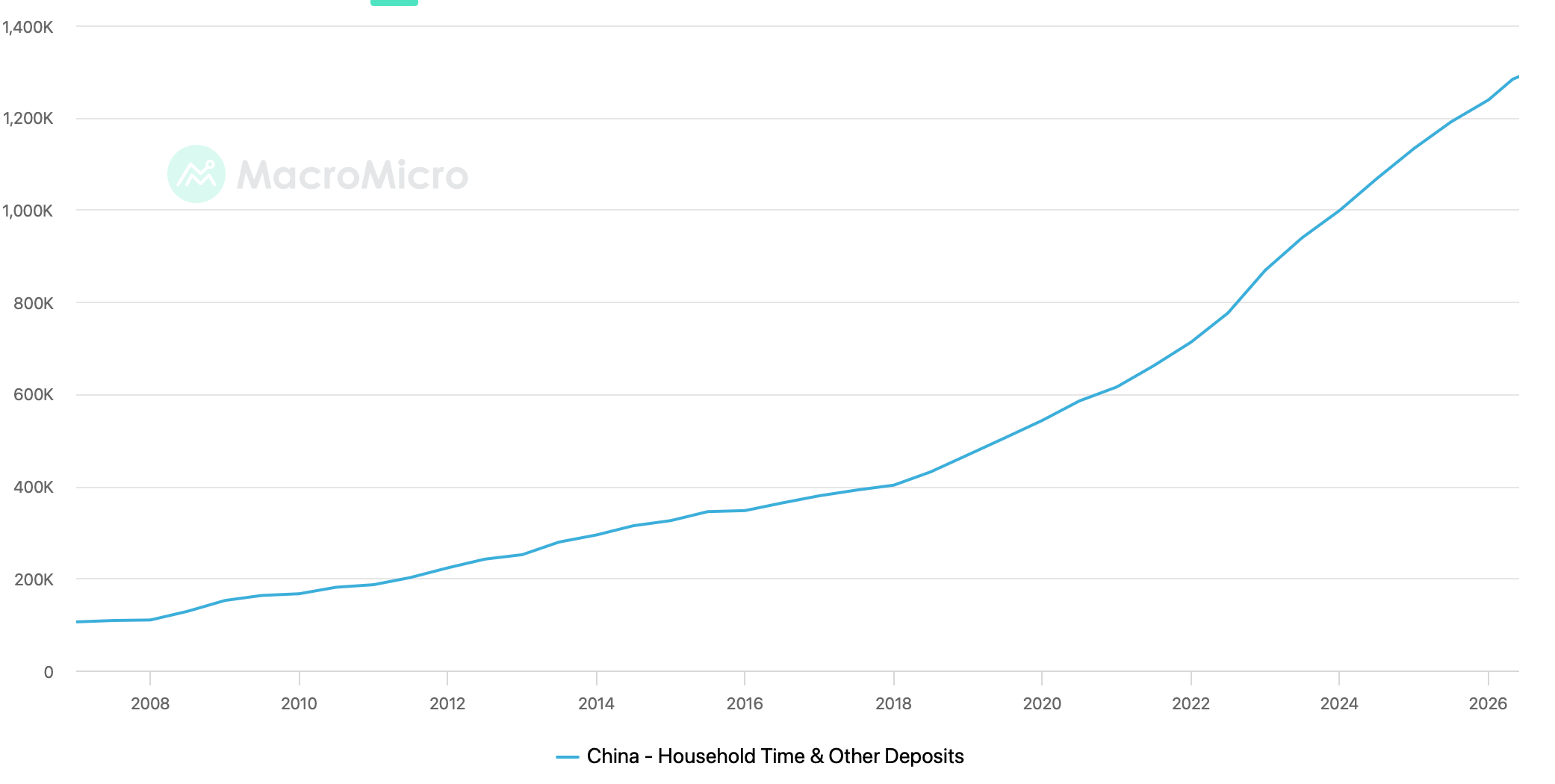
And they have been sitting in enormous and growing quantities. Chinese households now hold 173.48 Trillion yuan (approximately 25.6 Trillion USD) in time and savings deposits, a figure that has bent sharply upward since 2022, as money that would once have gone into a second flat has flowed into the bank instead, to earn almost nothing. This is not a sign of confidence. It is the reverse, a nation saving harder precisely because the thing it used to save into no longer feels safe, and because there is nowhere else for the money to go. Rather than open the exits, the state has been closing them further. In the spring of 2026 the authorities moved again to tighten the channels through which money could be sent abroad, confining what outbound investment remained to a handful of state-supervised routes.
A country has recognised, in effect if not in name, that it cannot go on pouring its savings into the ground beneath its cities. It has acted, deliberately, and with a control few states could match, to stop. In doing so it has produced an enormous and restless pool of national savings, with the old destination closed, the foreign exits barred, and no new home of any real size yet built.
Money like that does not stay still. It has to go somewhere. The question of where is the one the Chinese state has spent the years since trying to answer, and the answer it has reached for begins to reshape not only China but the world beyond it.
The Factory at the End of the Universe
The money had to go somewhere, and the state had a destination in mind. If the disease was that the nation poured its capital into the ownership of scarce things, the cure looked plain enough, point the capital instead at the making of useful ones. Stop rewarding the man who owns the land and start rewarding the firm that builds the factory. Take the savings that had been flowing into flats and channel them into plant, machinery, research, the physical capacity to produce. This is, near enough, what the first part of this argument would prescribe. Scarcity concentrates wealth by making things dearer. Production compounds it by making things cheaper and more plentiful. If you must choose where a nation’s savings go, abundance is the better bet.
This is broadly how China avoided the consequence of a Rentier Black Hole that the West could not. The hollowing that shows up as declining production in the Western cases shows up, in the Chinese case, as booming production.
In the West, the black hole drains industry precisely because the allocation is made by dispersed private hands, each optimising on its own account, and for each of them the certain return on land beats the risky return on a factory. No one intends the hollowing; it is the sum of a million rational private choices, and capital finds the rent on its own.
That choice was never China’s to make in the same way, because the allocation was never private. The state sat at the tiller, directing the flow of the nation’s savings, and the state answered to motives no private allocator carries, employment, industrial capacity, the self-sufficiency of a country that intends to depend on no one. So it did the thing no rational private investor would, and forced the savings into production long past the point where the return justified it.
The black hole did not vanish. Its symptom was diverted. Where the private machine drains capital out of industry, the state machine jammed it in, and the bill for that would come due in another currency.
Given a decade and a torrent of capital, it built the deepest industrial base the world has ever seen, and then it built more. It came to dominate the manufacture of the very things the future is supposed to be made of: the batteries, the solar cells, the electric cars, the drones, the components without which the rest of the world cannot build its own green transition. Where the West debated industrial policy, China simply executed it, at a scale and speed that left established producers in Germany, Japan and Detroit staring. By the middle of this decade it was not merely a maker of cheap goods. It was the maker, of some of the most advanced goods there are, and the price of nearly everything it touched came down.
And there, in that last clause, the trouble begins. Because production has a property that scarcity does not, and it is the property on which this whole story turns. Productive capital runs into diminishing returns. Scarcity does not.
Consider a farmer. Give him his first tractor and his output leaps, one machine does the work of many hands, and the harvest he can bring in multiplies. Give him a second and he gains again, though by less. By the time you have handed him his tenth he is not ten times the farmer he was with one, he has more machines than fields to drive them across, and the tenth sits idle in the barn for most of the year. Each tractor after the first adds a little less than the one before. Build the first steel furnace in a region and you create an industry. Build the fiftieth and, at some point, you are producing so much steel that the price of every tonne, including all the tonnes from the other forty-nine furnaces, begins to fall. The return on the next furnace does not merely shrink. It can turn negative, dragging down the return on all the furnaces already standing.
Scarcity behaves in exactly the opposite way, and this is why the black hole was so stable to begin with. You cannot build a fiftieth Shanghai to drive down the value of the first. The location does not saturate. Its return does not fall as you add more of it, because you cannot add more of it. Land, the scarce thing, holds its yield precisely because it cannot be reproduced. Productive capital, the abundant thing, erodes its own yield precisely because it can. Pour a nation’s savings into scarcity and the returns hold, which is a slow disaster for everyone who has to pay the rent. Pour the same savings into production, past a certain point, and the returns fall, which is a different kind of problem, and the one China now has.
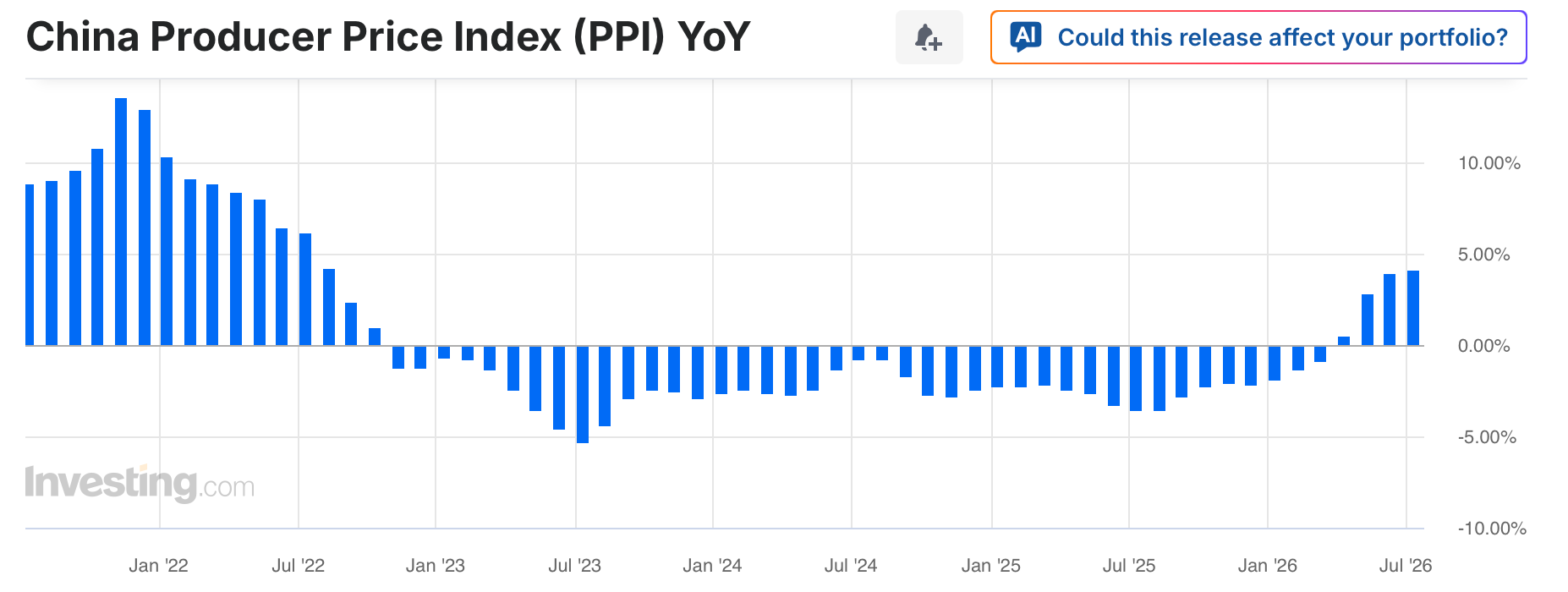
For roughly three years, from late 2022 into the opening months of 2026, the prices Chinese factories charged at the gate fell, month after month, one of the longest runs of producer-price deflation any major economy has recorded. And it was not weakness spread evenly. It was concentrated, tellingly, in exactly the industries into which the most capital had been poured. The advanced-manufacturing sectors at the centre of the national strategy were the ones posting the steepest price falls, and by 2025 they carried the highest share of firms actually losing money, more than a third of them, worse than the industries that had been starved of investment. The more a sector had been favoured, the thinner its margins had become.
The Chinese have a word for this, and it is a revealing one. Neijuan (内卷), usually translated as involution, describes a frantic kind of effort that produces no advance: everyone working harder and competing more fiercely simply to stay in place, or to fall behind more slowly. It began as a term for the exhausted striving of students and office workers. It migrated, accurately, to whole industries, dozens of solar firms and carmakers locked in a race that swallows ever more capital and returns ever less, each cutting prices to survive, all of them together destroying the profit of the sector they share. Involution is diminishing returns experienced from the inside. It is what the fiftieth furnace feels like to those who built it.
There is a formal name for the same trap seen at the level of the whole economy, coined by the trade theorist Jagdish Bhagwati: immiserising growth. A nation can, in principle, grow its way to being worse off. China is not there, and it may never be. But the mechanism is plainly at work. The abundance it manufactures is real, and it is a genuine gift to the world’s consumers. It is also, for the producer, a falling return on an ever-larger pile of capital.
Where does the surplus go? Some of it, unavoidably, abroad. A country that produces far more than it can consume must sell the difference to foreigners, and China’s trade surplus has swollen to a record, well over a trillion dollars of goods sent out into the world beyond what it takes back in. This is the overflow valve of the whole system, the excess capacity, unable to earn its keep at home, pushed out across the borders, which is why the rest of the world has found itself awash in cheap Chinese manufactures, and why tariff walls have begun rising to meet them. But a valve is not a cure. It relieves the pressure, it does not remove the cause.
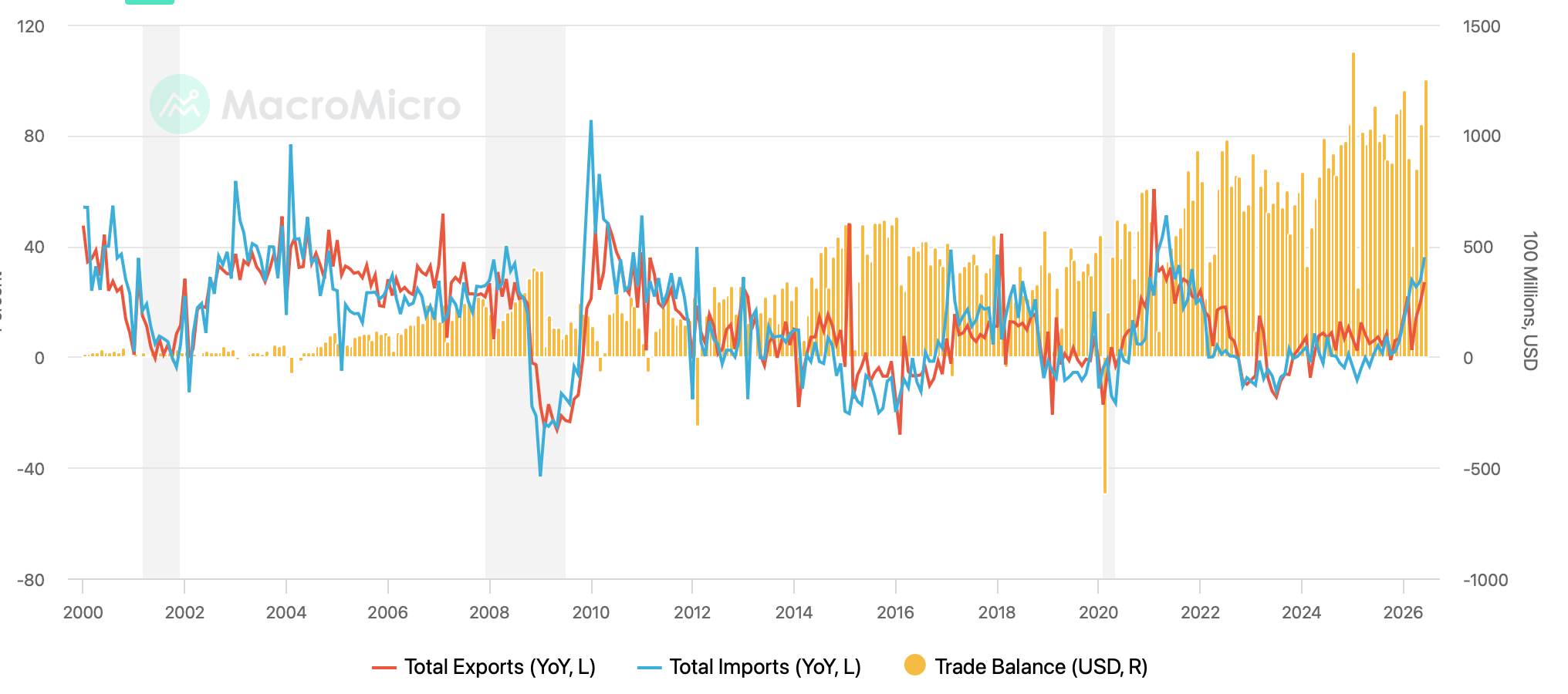
And here the story rhymes with itself. Faced, a few years earlier, with capital piling into property until the machine grew dangerous, the state had reached in and throttled it. Faced now with capital piling into production until the factories were eating one another’s margins, the state has done the same thing again. Beginning in 2025 it launched what it calls a campaign against involution, ordering capacity cuts, leaning on the worst of the price wars, telling whole industries, in effect, to stop building furnaces nobody needed. And it worked, at least in the narrow sense. By the first half of 2026 factory-gate prices had stopped falling and turned upward once more. Two machines that drew in the nation’s capital and gave back too little of value, two deliberate interventions to shut them off.
Which leaves it, and us, exactly where the logic has been pointing all along. Set out the options facing that enormous pool of trapped national savings and count them off. It cannot go back into property; that was the black hole, and in any case it is still deflating. It cannot keep flooding into domestic industry without limit; that is the furnace problem, and the state has just moved to stop it. It cannot sit in cash; deposits earn almost nothing, and 173.48 trillion yuan is already there doing precisely that. And it cannot, under the rules as they stand, simply flow abroad in search of a better return, because the border is shut.
Every domestic door is either closed or closing. And this is the point at which a certain kind of arithmetic becomes irresistible. If the return on the next furnace at home has fallen close to nothing, then a return available somewhere else, even a distant one, even a risky one, even one that must be built from the ground up in a country on the far side of the world, starts to look not charitable but merely rational. The tenth tractor is worth little to the farmer who already owns nine. It may be worth a great deal to the farmer who owns none.
That single comparison, between the exhausted return on capital at home and the untapped return on capital abroad, is the engine of everything that follows. It is why the ships leave port.
The Treasure Ships
The trapped savings split in two: the state's capital could leave the country, the household's could not. The first became a fleet, and this part follows it out to sea. The second was left to find whatever door remained at home, which we cover fittingly at the end.
So the state’s ships leave port. Denied a home for its savings inside its own borders, China’s capital turns outward, and here the story could become, for a moment, almost utopian.
China takes the savings it can no longer profitably invest at home and sends them to the places that have almost none. It builds a railway across a country that had no railway. The railway lowers the cost of moving goods, and a factory that made no sense before the railway suddenly makes sense. The factory raises the productivity of the people who work in it. Higher productivity, in time, means higher wages. A person with higher wages is the thing China now needs more than almost anything else in the world, a customer. He buys a Chinese motorbike, a Chinese phone, a Chinese solar panel. The demand that China’s own saturated market could no longer supply is manufactured, from nothing, on the far side of the world. China has built its own customer.
Capital flows from where its return has been exhausted to where it has barely begun, and in doing so it does not run into the wall of diminishing returns, because it has moved the wall. It has enlarged the frontier of the world economy rather than crowding further into the part already built. The part that makes the whole thing more than wishful is that none of it requires China to be kind. It does not build the railway because it loves the people at the far end of it. It builds the railway because, one day, they might buy the train.
Here lies our difficulty, considering a railway. It raises the productivity of a place, and therefore the value of being in that place. But we have already established what happens when the value of being somewhere rises and the somewhere cannot be reproduced. The gain does not float free as higher wages for everyone. It capitalises into the price of the land around the station, the ground beside the new port, the plots along the new road. By the framework’s own first principle, a productivity gain that lands on a fixed location becomes rent before it becomes a wage, and it is captured by whoever owns that location. The railway that was meant to lift a nation’s workers can just as easily lift a nation’s landlords, and leave the workers roughly where they were, now paying more to stand near the thing that was built to help them.
Which means the hopeful loop carries a hidden condition. For the productivity to become wages, and the wages to become the demand China is counting on, the country receiving the railway must capture the location premium for its people rather than let it pool in private hands. It must, in other words, do the one thing this entire framework has spent every previous part explaining that countries cannot do: tax the land, hold down the rent, and refuse to let a new rentier class form around the new infrastructure. The benevolent loop is real. It is also conditional on a land value tax, which is to say conditional on the single reform the theory predicts will always be defeated. Left to itself, the treasure ships do not end the Rentier Black Hole. They seed new ones, abroad, wherever they make a place valuable and let someone else own it.
So everything turns on a single question. When the railway raises the value of the land, who gets the uplift? The gain can spread thin across the many, where the infrastructure is diffuse enough to settle nowhere in particular, a grid or a trunk road serving land too plentiful to concentrate it. It can be captured by China, which builds the port and owns the ground beneath it, taking the location premium back as the rising value of an asset it holds. It can be captured by the recipient’s own public, through the land value tax that would hold the rent down and let the gain become wages. Or it can go to no one at all, because the project never pays, and the port sits half-used and the loan is quietly restructured into the long ledger of visionary infrastructure that became a distressed asset.
Read down that list and the cruelty of it is plain. The arrangements that maximise development, the diffuse gain and the land tax, provide China with the weakest and slowest return. The one arrangement that secures China’s return, self-capture, converts development into rent extraction and develops nobody. A state choosing between these on cold self-interest, project by project, is not choosing between good and evil. It is choosing between a certain return that helps no one and an uncertain return that might, and we know which way that choice tends to fall.
Economists have long puzzled over why capital does not, in fact, pour from rich countries to poor ones, despite the enormous returns that ought to await it there. The standard answer, due to Robert Lucas, is that the returns are not really higher once you account for everything that can go wrong: weak institutions, unenforceable contracts, the risk that your factory is nationalised or your loan repudiated. Capital stays home not because it is timid but because, once the risk is priced in, home is genuinely where the return is.
The places where property is secure, contracts hold and arbitration is reliable, are not a random sample of the poor world. They are, overwhelmingly, the places that have built the strongest protections for ownership. The economies in which the very safety that attracts foreign capital is the same institutional machinery that lets land and property become an untouchable store of private wealth. Secure property rights are what make a country safe to invest in. Secure property rights are also what make a Rentier Black Hole possible. The same protections that cover IP, Factories, contracts, shareholders, also protect the ownership of property. They are one thing, seen from two sides.
So the capital does not, in the end, sail for the capital-starved frontier where the marginal return is highest and the risk of losing everything is highest too. It flows, as it always has, towards the securest ground it can find, which means towards the property of the rich and the near-rich: London, New York, Sydney, the safe cities where a foreign buyer knows the title will be honoured. Lucas is not an obstacle the treasure ships must overcome on the way to enriching the poor. Lucas is the current that keeps them from ever setting out for that shore in the first place. The development loop asks capital to go precisely where it is most afraid to go. The rentier loop is simply where the safe returns already are.
And when we stop theorising and look at where China’s outbound capital has actually been going, the theory is confirmed with uncomfortable precision. In the first half of 2025, the most recent period for which the full breakdown has been tallied, China’s overseas engagement under the Belt and Road reached its highest level for any six-month stretch on record, well over a hundred billion dollars. But the composition tells the story the theory predicts, not the one the hopeful loop requires. The largest destination was energy, and within it oil and gas, more in six months than in the whole of the year before. The second largest was metals and mining, a record in its own right, much of it plain extraction. Money poured into securing resources, and into relocating China’s own factories abroad to leap the tariff walls now rising against its exports. The connective infrastructure the hopeful loop actually depends upon, the roads that would raise a region’s productivity, the ports that would open it to trade, dwindled to the lowest level in the programme’s entire history. Not one new port was recorded in a Belt and Road country at all.
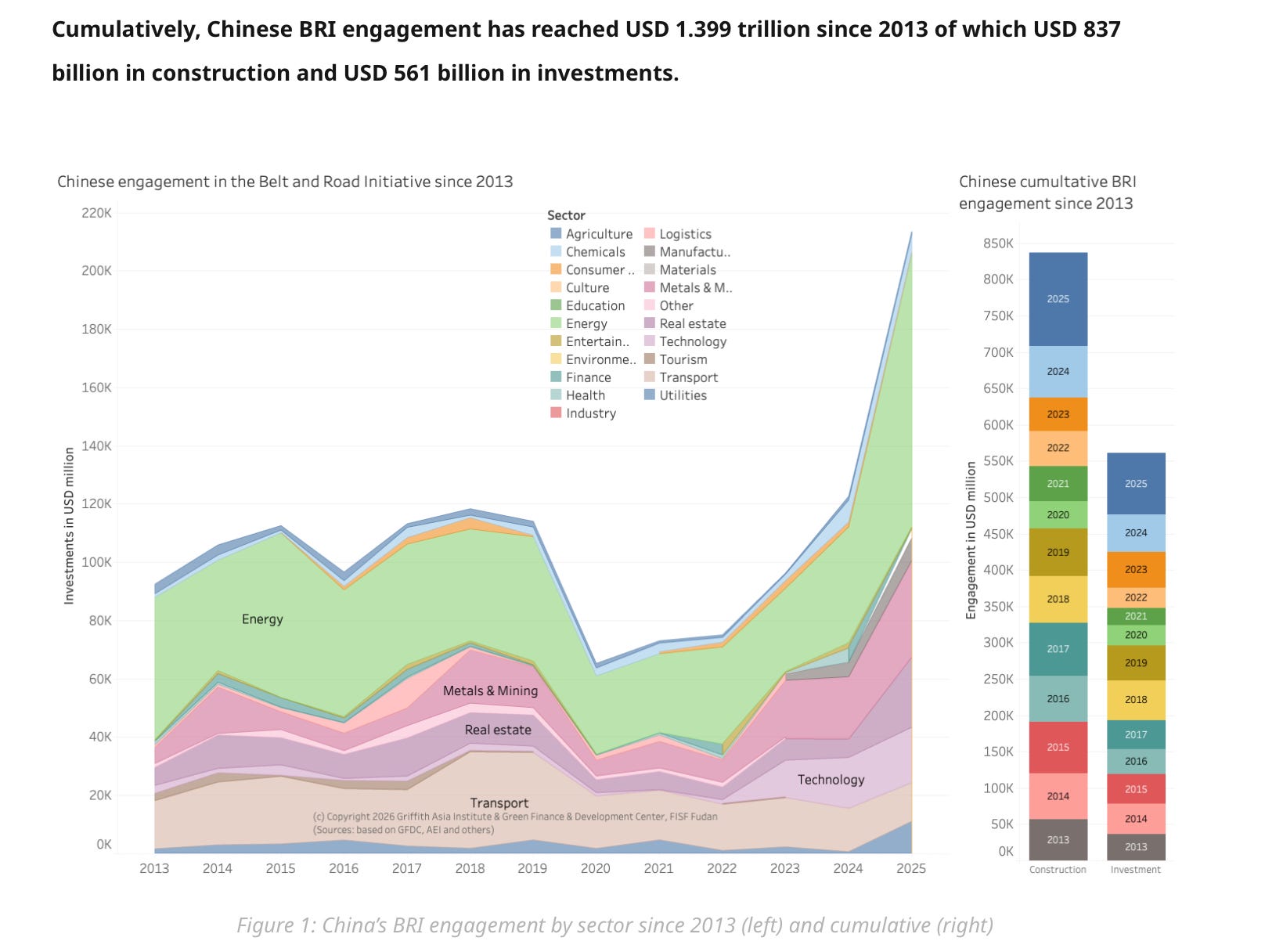
The people who compile these figures put the matter more bluntly than any critic would dare. The large projects, they observe, are resource-backed deals rather than development financing, and are structured to carry unusually low financial risk to the Chinese side. That is not the profile of a benefactor building customers. It is the profile of a landlord acquiring assets.
There is one further reason the benevolent version was always going to struggle, and it lives inside the loop rather than outside it. Suppose China did raise a country’s productivity, patiently, all the way up. What it would have built is not a permanent customer but a temporary one, because a country productive enough to buy Chinese machinery is soon productive enough to make its own. Japan made customers of the world and then watched Korea take its markets; Korea did the same and then watched China take its. The ladder does not stop climbing to wait for the country at the bottom. The very success the loop depends on turns the customer, in time, into the competitor, which only sharpens the case for taking the guaranteed thing now, the oil, the copper, the asset, over the patient thing that may one day compete with you.
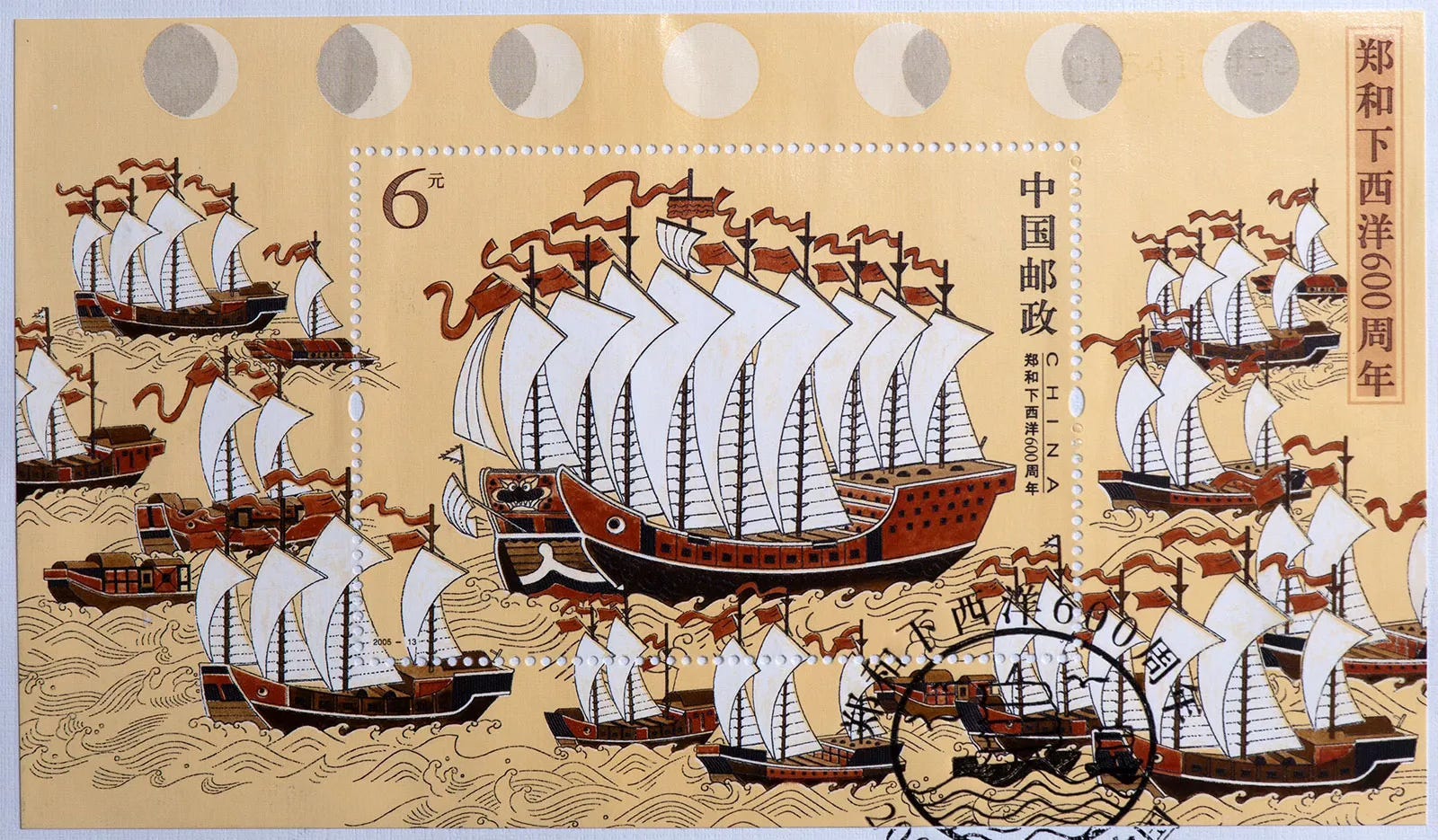
There is a grim joke folded into the name. The original treasure ships were Chinese: the enormous fleets of the admiral Zheng He, which six centuries ago sailed further than any European yet had, out across the Indian Ocean to the coast of Africa and back. They were not, whatever the romance suggests, engines of development. They carried tribute and demanded recognition, and then they were called home, the fleet left to rot, the shipyards closed, the whole outward-facing enterprise abandoned by a state that decided its future lay in turning inward. The treasure ships are, historically, the symbol not of a China that enriched the world but of a China that reached out once and then shut the door. It is worth remembering, when imagining what the next fleet might do, that the last one was recalled.
So we return to the question the whole diagnosis was undertaken to answer, now sharpened to a point. Is China, after the bust, the diagnostician who sails out into the world to cure the disease it survived, or the landlord who sails out to spread it?
The honest answer is that the theory permits the first and the evidence, so far, shows the second. The benevolent loop is not a fantasy. It is a real thing the mathematics allows, and it does not even require China to be good, only for the return on capital at home to have fallen far enough that a return abroad, in whatever form, is worth reaching for. That condition is evidently met; the ships are unmistakably sailing. But between the two cargoes they might carry, the development that enriches the recipient and the extraction that enriches only the owner, self-interest chooses the second, because the second is guaranteed and the first is not. The ships are sailing. They are sailing for oil and copper and cheap land, not for wages. The diagnostician and the landlord put out in the same vessels, on the same tide, for the same reasons, and only the cargo tells them apart.
Whether that ever changes rests on the one thing the whole framework says it will not: whether the countries receiving the ships can capture, for their own people, the value that lands on their soil, rather than letting it pool in the usual private hands. If they could, the treasure ships would genuinely enrich them, and enrich China in turn, and the loop would close as the hopeful version imagines. They almost certainly cannot which is why the optimistic reading, though real, is unlikely, and the extractive one, though bleak, is where the evidence points.
The capital that arrives from abroad is only ever a wind. The thing it topples is a house of cards, and the cards were stacked, by the country that receives them, on a windy day. A rentier state near collapse, its property inflated, its coalition of owners defending the structure to the last, is a house that will fall to the first strong gust from any direction. When the gust comes wearing Chinese colours it is tempting to blame the wind. But the wind did not build the house, and it did not choose to stack it on open ground in a rising breeze. The most that can be said of the treasure ships, in the end, is that they have become very good at finding houses that were always going to fall, and at being there, holding the deed, when they do.
The Tigers of Canton
Return to the fleet that could not sail. The ships were the state’s, the 173.48 Trillion yuan in the nation’s savings accounts was never allowed on deck. An ordinary saver may still take only his fifty thousand dollars a year past the border, and may not lawfully spend even that on a foreign share. So while the state’s capital crossed the water in search of oil and copper and cheap land, the people’s capital stayed home, pooled, and went looking for the one exit still left to it. A pool of money denied every door but one will always find the one.
The one is a channel called Southbound Stock Connect, a single licensed pipe running from the mainland’s brokerages to the stock exchange of Hong Kong. It is not a breach in the wall. It is a gate built into the wall, quota’d and monitored and settled in yuan, precisely the sort of state-supervised route to which the authorities confined what outbound money remained when they tightened the controls in the spring of 2026. The border did not open. One licensed port was left standing.
There is an older rhyme in that than the modern name admits. When the Ming and then the Qing turned their backs on the sea, they did not merely recall the fleets. They funnelled what foreign trade they would still permit through a single licensed harbour, so that for the better part of a century every Western cargo that entered China entered through one port on the Pearl River Delta. Canton. Six hundred years after Zheng He’s ships were called home and the shipyards left to rot, the wall is back, and the single gate in it is back, and it opens onto the very same delta. Canton then, Hong Kong now. A state that has spent this essay walling its wealth in has left, exactly as its forebears did, one door to the water.
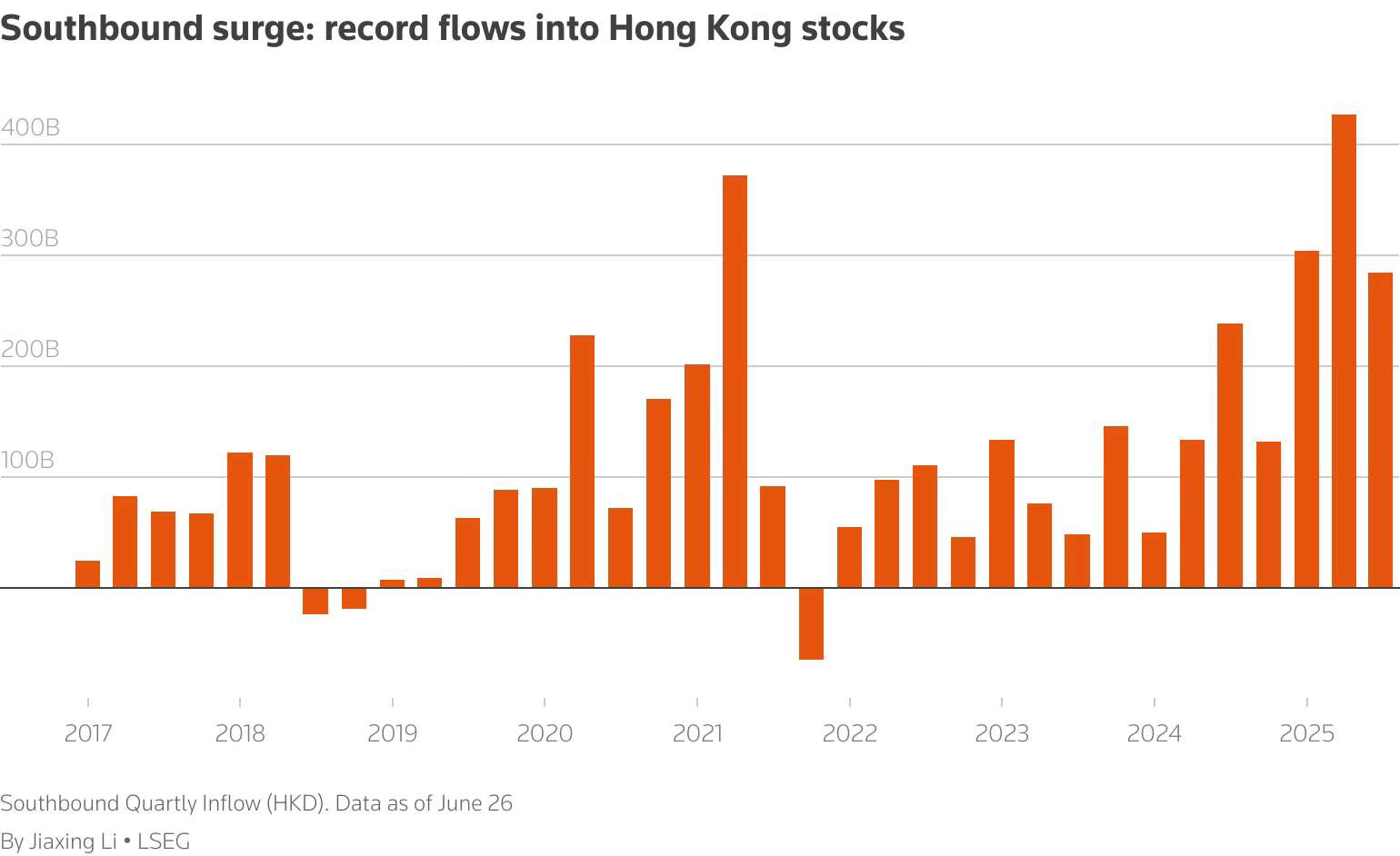
In 2025 the money running south helped make Hong Kong, for the first time since 2019, the busiest market for new share listings anywhere on earth. In the first half of 2026 raising HK$209.9 billion across 85 IPOs, a 92% increase in funds raised and a 102% increase in the number of IPOs compared to H1 2025.
And what the money reached for, above all, were the companies the moment adored, a cluster of barely revenue-generating artificial-intelligence firms the market had taken to calling the tigers, listing into first-day gains that belonged to another era. Lightelligence, listed in April 2025 surged 408% on its first trading day. Zhipu AI up 13% on its IPO day, to HKD$131.5 on January 8th 2026, hit a high that June of HKD$2980, a >2200% gain, in 6 months. The valuations tell the same story from the other side Minimax’s price sales ratio currently sits at 106.45x, Zhipu AI at 583.31x. Even in the terms of the AI arms race, these valuations are ‘chunky’.
The recent correction does not refute the diagnosis. Shares unlocked, early investors took their profits, competitors shipped stronger models, and the prices came off. But note what the firms did in response, Zhipu and MiniMax met the demand by issuing new equity, raising billions to finance ever larger clusters. That is the signature of a flow, not a verdict on value, capital arriving faster than the companies can absorb it, and the companies printing paper to soak it up. These are the ordinary fluctuations of a young and capital-intensive industry, and they are beside the point. The claim is not that these are good businesses, nor that they are bad ones. It is that once the property door closed, a remarkable quantity of Chinese household savings found itself trying to squeeze through one of the few doors left open, and the price of whatever stands on the other side moves accordingly.
The wheel is the oldest one in finance. The rising price draws the money, and the money lifts the price, and for a while it turns on its own.
Recall the below-reference cohort, and the three moves left to anyone standing beneath a benchmark that keeps receding: work harder, though the line outruns the wage; lie flat, and stop; or stake everything on one risk in the hope of clearing the gap in a single bound. Recall, too, the instruments that risk had once been taken in. The pre-sold flat, small and levered and believed to be underwritten by the state, is gone, taken down with the developers. The wealth products are gone, taken down with the trusts. The domestic exchange was never trusted. One by one, on grounds of prudence or vice or simple collapse, every venue on which the below-reference saver might have placed the great bet has been closed, until a single wheel is left still turning, in Hong Kong, and a whole cohort turns towards it at once.
This is the oldest architecture of a bubble, it is the architecture that produced 1929 by our diagnosis. Not a mania, not a madness, but a rational convergence. Take a large population held below a reference that keeps climbing out of reach. Give it, through real wages that go on rising inside a deflation, more dry fuel than it has ever carried. Bolt shut every speculative door but one. The pressure that has nowhere else to go will find the door that remains and lean on it until something gives. The tigers are not being bought because a nation has lost its mind. They are being bought because a nation has done the arithmetic, and the arithmetic leaves one answer.
That this is flow and not judgement can be shown more cleanly here than almost anywhere, because many of these firms are listed twice, once on the mainland and once in Hong Kong, the same company, the same earnings, two prices. For a decade the Hong Kong price sat at a stubborn discount to the mainland one.
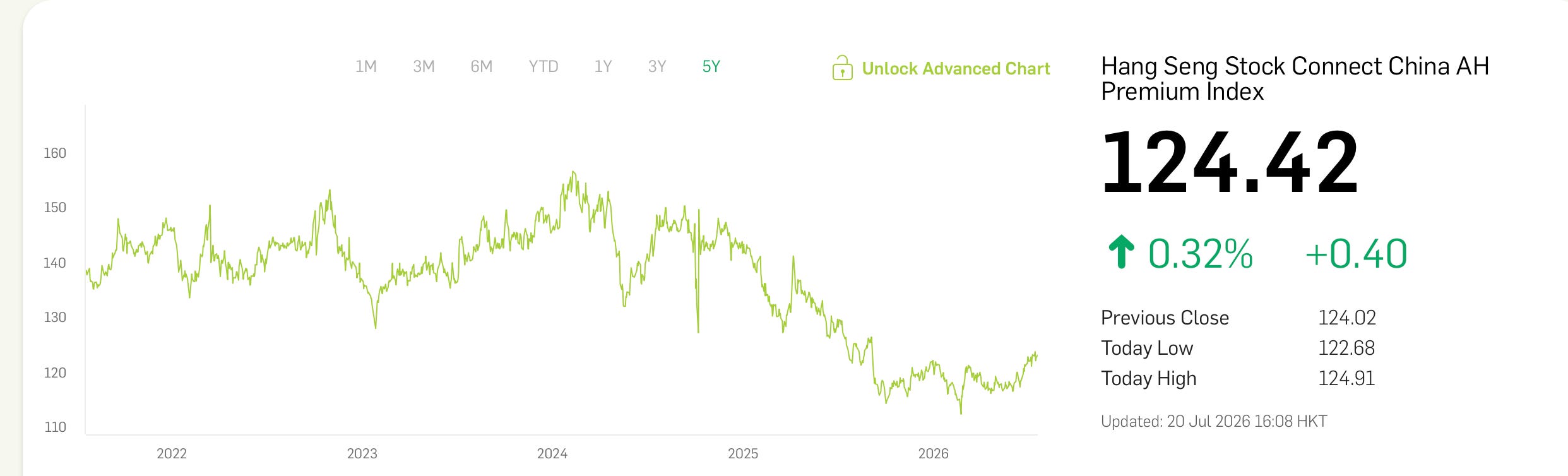
Into 2026 that discount fell to its slimmest in five years, and for some names it turned over entirely, the battery giant CATL coming to trade dearer in Hong Kong than at home. Nothing about the company differed between the two tickers. Only the buyer did, and where the mainland saver is now the marginal bidder, he prices the asset not toward the world’s estimate of it but toward his own.
China’s households held 173.48 trillion yuan in bank deposits. The record southbound flow into Hong Kong over the year to March 2026 was around one trillion yuan, in context that is 0.58 percent of the ‘reservoir’ of Chinese excess savings. Yet it was already sufficient to account for a large share of Hong Kong turnover and compress the discount on mainland companies’ Hong Kong shares. The flood had not arrived. The market was moving under the weight of the first leak.
So the setup rhymes with 1929, and it is worth being exact about where the rhyme holds and where it breaks. What repeats is the funnel: a large cohort held below a rising reference, handed more fuel than ever by real wages that climb inside a deflation, with every speculative door bolted but one, converging by cold arithmetic on the venue that remains. That machinery is genuinely present. What does not repeat, at least not yet, is the fuse. The crowd of 1929 was levered on margin, so a fall in price forced a sale, and the sale forced the next, and the market came down in a single autumn. This crowd is, for the most part, not levered at all. The saver buys his tiger outright and can lose only his stake. Take away the mechanical selling and you take away the crash, and what remains is not 1929 the event but 1929 the pressure, the same crowd at the same kind of door, without the powder keg beneath the floor.
There is a second reason to be slow with the word crash. This is a state that has already reached into the machine twice and switched it off, once when it throttled the developers, once when it moved against involution. It can reach in a third time, and it holds the levers to do it, for the door itself is a quota. Southbound flows, listing approvals, the whole width of the gate are the state’s to narrow. A regulator in 1929 could only watch the tape. This one built the valve, and can close it. Whether it does so in time, or too late, or in a panic, no one can say. But the option exists, and its existence alone tilts the odds away from the sudden ending and towards the slow one.
Which is the graver risk, and it is not a crash at all. The ignition may be American. but the burn might be Japanese. but a long, grey deflation, in which the bad debt is never cleared, only carried. For the leverage that matters was never in the saver’s hands. It sits one deck below, on the balance sheet of the state itself, in the credit that raised the tigers’ world: the state banks, the local governments and the sovereign bonds that financed a wall of data centres for the models to run on, a wall of which, by the most recent reckoning, as much as four-fifths stands idle, some of it built for domestic chips that do not yet exist. Whether that risk is large or small turns on a single figure this essay cannot yet responsibly name, the scale of that state and local-government credit behind the build-out. If it is modest, a fall in the shares is a private disappointment and little more. If it is vast, the state has quietly written itself a bill it will be paying down for a decade, in the Japanese manner, whether or not the tigers ever crash at all.
The Flood
A state looked at the machine that hollows out nations, the private scramble into the ownership of scarce things, and it reached in and redirected the flow by its own hand. It pointed the nation’s savings at production rather than at the endless recapitalising of old bricks, and in a single generation it built the deepest industrial base the world has ever seen and became its dominant exporter. Real wages rose for hundreds of millions. Whatever else is said here, that is among the largest improvements in human material life ever compressed into so short a time. There is a lesson in it for every economy that let its own capital drain into land: a policy, even a heavy-handed one, can pull a country back from the event horizon, if it insists that savings build things rather than merely own them.
But the disease was only ever diverted, not cured, and the rest of this essay has been the bill arriving. A state may own all the land outright, as China’s does beneath its seventy-year leases, and still generate a rentier black hole, because ownership was never the point. Scarcity was. Booming productivity has to capitalise somewhere, and no quantity of concrete, not more than the United States poured in the whole of the twentieth century, can manufacture a second Shanghai. The value pooled where it always pools, on the ground that cannot be reproduced.
To its credit, the state kept reaching in. It saw the speculative engine its developers had become and switched it off deliberately, buying a slow deflation in place of the sudden smash the West took in 2008. It saw the involution its own success had bred and moved against that too. Each intervention worked, more or less, on its own terms. But the sum of them was a wall, and behind the wall a rising flood: a nation’s savings sloshing in a sealed room, every familiar exit closed, waiting for a release.
The trapped savings have split in two. The state has done the thing this nation once did six centuries ago. It has loaded its treasure and set out for distant shores, and we cannot yet say which cargo it truly carries, the development that would enrich the world and make customers of it, or the quiet appetite of an owner seeking only the stable return it was starved of at home. But the ordinary saver, shut out of every room, has found the one crack in the wall, and glimpsed through it a small, bright, AI-shaped lottery ticket on the far side.
What has come through so far is only a trickle from a reservoir measured in the hundreds of Trillions. The flood has not yet begun.
Henry Fudge is a writer creator and entrepreneur based in Switzerland. His work focuses on political economy, capital allocation, housing markets and the long-term consequences of rent-seeking institutions. He is the creator of the Rentier Black Hole framework, which examines how modern economies increasingly concentrate savings into existing assets rather than productive investment and the dark consequences of it.
Subscribe for weekly essays on economics, finance and public policy.
Further Reading
What is the Rentier Black Hole?
Reference dependent utility and risk seeking how does that work?
I cannot begin to describe how grateful I am for this publication. It has answered so many questions about China that have puzzled me for years including their huge spending on reconstruction of transport through former African Colonies. And yet, if you ever go to remainder shopping developments like Bicester Village in the UK, you will see coach loads of Chinese arriving with empty suitcases and leaving with full ones packed with clothes. Many of the items made in China, Vietnam or Indonesia and taken back to China for sale to friends. Never quite sure why unless it is for brands not available in China.