
The Lake
Reference Dependent Utility explained with a lake, a boat and a drowning man

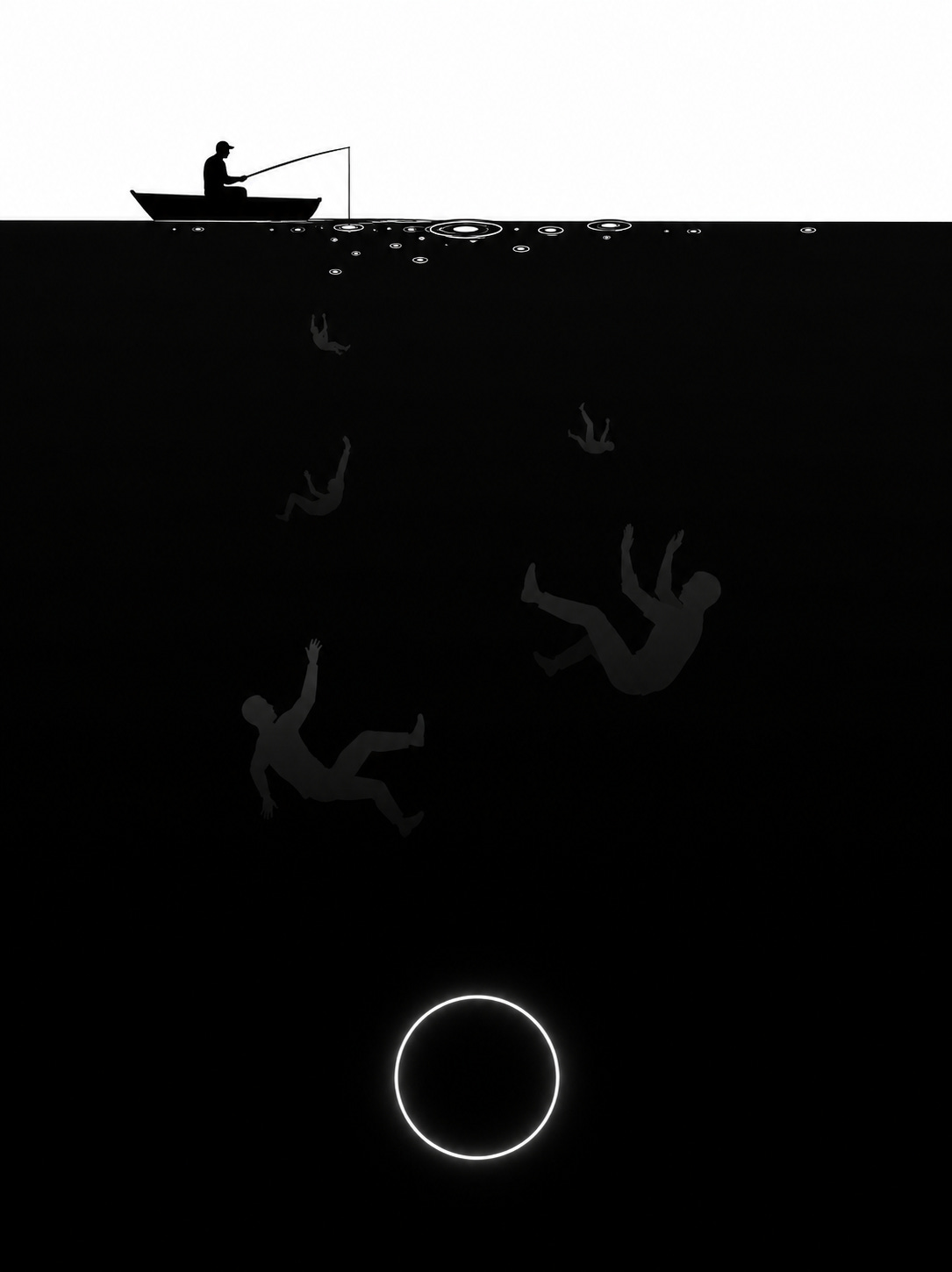
Within the framework I have built around the Rentier Black Hole, one element of it is the most interesting and misunderstood. Reference dependent utility. It sounds rather intimidating, or conceptually difficult, and so I thought I might give a simple metaphor that most anyone could understand, and quite a few of us already feel.
To understand it, you need a lake, a boat, a fisherman and a drowning man.
The lake
You are at a lake. The surface is relatively calm, the weather is quite fair up here. There’s a man in a boat, rather relaxed, he casts a line over the side, soaks in the sun with a beer in hand.
A small bubble rises to the surface. A hand reaches out of the water, grasping the edge of the boat. He hauls himself in. The panic on his face has dissipated. The fisherman hands him a beer and a rod.
“How did you get up here?”
The nearly drowned man coughs out
“I guess I must be a good swimmer.”
Below the boat, there are still more bubbles coming up. The water seems to be rising. The bubbles seem to be growing.
Above
You are in the boat. You got yourself into the boat. You struggled under the water for some time.
You must be a good swimmer. Maybe simply stronger than the others. Possibly they should have learned to swim.
This is being above the reference. The framework of our reality is often dictated by our position. Even those who have been ‘under the water’ once above, adopt the language of the boater.
I earned this position. I worked hard. Getting into the boat is the rational option, swimming is rather tiring after all. This is not objectively wrong. Within this reference, it is a perfectly rational world view. Nobody handed you the boat.
Once you are ‘in the boat’, life is all more rational. You may crack open a beer, consider where to steer the boat for a better catch, or focus on the fishing.
Above the reference in reference dependent utility, agents are what we commonly understand in economics as rational, they make reasonable risk averse choices. They optimize on rational parameters as we would expect them to.
Below
There is a man drowning. Sucked below under a cold black current. The surface is pulling away from him faster than he can swim.
He struggles, he frantically writhes, he moves wildly, in any attempt grab something that might pull him back to the surface, even something flimsy and nearly impossible to help, a small branch that might snap. He is still sinking.
At the bottom, his breath gives way. The water enters his lungs, and he screams. The bubbles filter out to the surface as the ice cold water floods in.
He continues to sink.
It is not often a drowning man simply stops swimming. Usually as the darkness closes in, and the water takes you down, the further you go the more frantic you become, as the surface pulls away from you.
If he made it an inch closer to the surface before sucking in the water, he would not have been better off. The answer is simple, you either get to the surface or you don’t.
Any frantic motion that is required to get to that surface is a matter of survival, made in a split second while you suck in water and attempt to simply not die. Any thrashing, grabbing, kicking, is all rational down here in the depths.
The further from the surface you are, and how fast that surface rises away from you, determines how visceral that panic becomes.
This the dark implication of reference dependent utility in our economies. The further below the reference you go, the more risk you are willing to take to reach a surface, you may even step on another poor soul down here to push yourself up. Anything to reach a surface is justified below the water.
If the man had tried to swim, with perfect form and pace, no wasted strokes. At a certain depth, if the surface is rising away from you, he still would have drowned. The rational prescription of swimming, is irrational if he still would not have reached a surface. There is nothing else to do but thrash, kick up off another drowning man, or grab for branches certain to break, because some chance always beats no chance.
Across the surface
The man in the boat has seen the bubble hit the surface, that left the lungs of a man condemned below. He peers over the side of the boat. Below he sees a man thrashing, panicked, grabbing at anything.
He says “You should have learned to swim like my friend here. I got my own way into this boat, you just can’t help some people.”
He doesn’t mean any of it as a condemnation. It’s simply the only advice that makes sense within his reference, what worked for him before the water rose so quickly.
The survivor beside him if anything is tougher about it, as survivors often are. He did get into the boat, he doesn’t remember much else, other than the man in the boat remarking what a good swimmer he must be.
The drowning man looks up. He sees the hull from below. He would shout help, but with little breath left and an expanse of water between them, to scream would only let the water in faster. He’s slightly more focused on trying not to drown as you could imagine.
The two references fundamentally from a difference in perception based on their placement relative to the reference, have no basis to understand the views of a person across the surface.
In our economic reality, we don’t often callously watch people drown, but we do often hear the same words. Work harder. Buy less avocado. Get an education. Have you considered moving somewhere cheaper.
None of this is strictly irrational advice, given from someone above the reference to someone below. Within their reference and their lived experience of how they got there, they believe truly that it was meritocratic, from their hard work, and to some degree, this is understandable. They only faintly remember swimming.
A Rising Tide
The man in the boat does not notice the water level rising or the speed at which it may be rising.
He is just as far from the surface as he was yesterday. He is further from the lakebed and where he started than ever, but he doesn’t carry an instrument to measure the depth, he just sees the surface.
The reference moves up, without anyone above it truly noticing it. The expanse of water below for those damned below, has grown faster and is now wider than ever. Certainly larger than when our sailor first swam to his boat in a time when swimming still worked.
Those in the boat are not doing anything to those below it. They simply sit above the reference buoyantly.
The Bubbles
Deep below the surface, a collection of the damned are choking for breath.
In all drownings there is a point when you realize the surface has escaped you, there is a feeling when ice cold water hits your lungs.
What comes out is a scream, the water floods in, the air displaced. Whether it was in terror, or simply the world “help” is irrelevant. Only the bubble reaches the surface.
The size of the bubble depends on how long you held your breath, and how many people are down there drowning.
Here the analogy and the economics are both quite dark. Below the surface, the risk preferences are distorted by the binary choice of reaching the reference point. The further away you are, the more severe it is. In our economies this is where we see desperate gambling, lottery tickets, high kurtosis bets. All things that broadly, are negative expected returns, they will generally lose you money, but they carry a tiny chance to get you above the reference, when all other strategies are guaranteed to fail.
For a rare few, the bubble rising from below was enough to push them and a hand above the surface. The rotten branch they grabbed held just long enough. They pull themselves onto the boat, for a towel and a beer, they did not see through the murky depths where the bubble came from.
In my framework, I believe it is reasonable to imagine, that the bubbles started with a scream that sounded like “help”
Multiple down below
Now consider that there are hundreds if not thousands of people down here, deep down below. All sinking and screaming at the same time.
The Lake is rather small, all of those bubbles together and the thrashing down below drives a current, is enough to disturb the man in the boat.
If enough people are risk seeking simultaneously below the reference, in a small enough market, the sum of their inflows is no longer absorbed by the venue. Individually, on negative expected value investments, they may lose quietly. Small bubbles rise to the surface. Collectively in a venue with limited capacity, enough inflow can affect the pricing, that pricing becomes recursively based on the inflow rather than fundamentals.
This is observed as irrational to those above the reference broadly, but below the water, nearly anything that can get you to a surface can be justified.
Whether this coordinated bubble and thrashing beneath the waves rocks the boat to a noticeable degree, or even capsizes it, depends on if there is a rope connected to the boat. The credit system.
Without a ‘rope’ the screaming and the thrashing below, may make some notable ripples on the surface, you may even rock the boat. The credit isolated venues pop below, with only a ripple at the surface.
With a ‘rope’, the yanking from below, from a thousand drowning souls screaming, can easily pull over the boat.
The difference between bubbles that ripple and bubbles that bang, is a rope Hyman Minsky named the Minsky collapse.
If you can’t see the water
Someone who cant see the water, sees a man in a boat calmly and reasonably enjoying their day at the lake. Looking down slightly he then sees some frantic man at the bottom acting rather strangely. Grabbing at things, kicking himself off another man. Screaming without words coming out.
He notes that there must be two types of people. Calm sailors, and an irrational few who are behaving quite bizarrely.
This is not an entirely ridiculous conclusion to a man who cannot see the water. This is roughly the current micro-economics that you are taught in your lecture halls. All agents are rational and utility maximizing. The poorest in society gambling at rates that correlate almost perfectly inversely to their position by relative wealth, is an anomaly they swat away in their mathematics.
The model is not strictly wrong, it was simply never constructed in the water, or by those who have ever dared to swim, in an institution far above the waterline.
When a Billion People Drown
A boat of any size, in a lake of any size, will notice the ripples of a billion below writhing, struggling and screaming.
It does require that those below still have the breath in their lungs to scream with, and energy sufficient to fight a dark current. Some lakes are simply quiet because the screaming stopped. Whether they are all in boats or graves is irrelevant.
The man in the boat doesn’t know whether the lake is still, whether a single man or a billion are down in the dark drowning.
If down below, a billion people are drowning, locked below a surface rising that they know they can never reach. The collective scream of a generation sinking, is loud enough to boil the water.
All ropes will be yanked, the bubbles at the surface when they arrive, are more than sufficient to flip any boat of any size.
If a billion people are below. You are not safe in a boat.
If it capsizes, you will then know that the water is colder, deeper and darker than the time you first learned to swim.
Brilliant, thank you. Now let us hope our leaders can fix the issue for those from the bottom upwards in the near future. The boat will then be in for some severe turbulence with reducing assumptions of entitlement.