Operation Defibrillator
Why Britain has a £2 trillion investment deficit, where the capital actually is, and how to redirect it without spending a penny

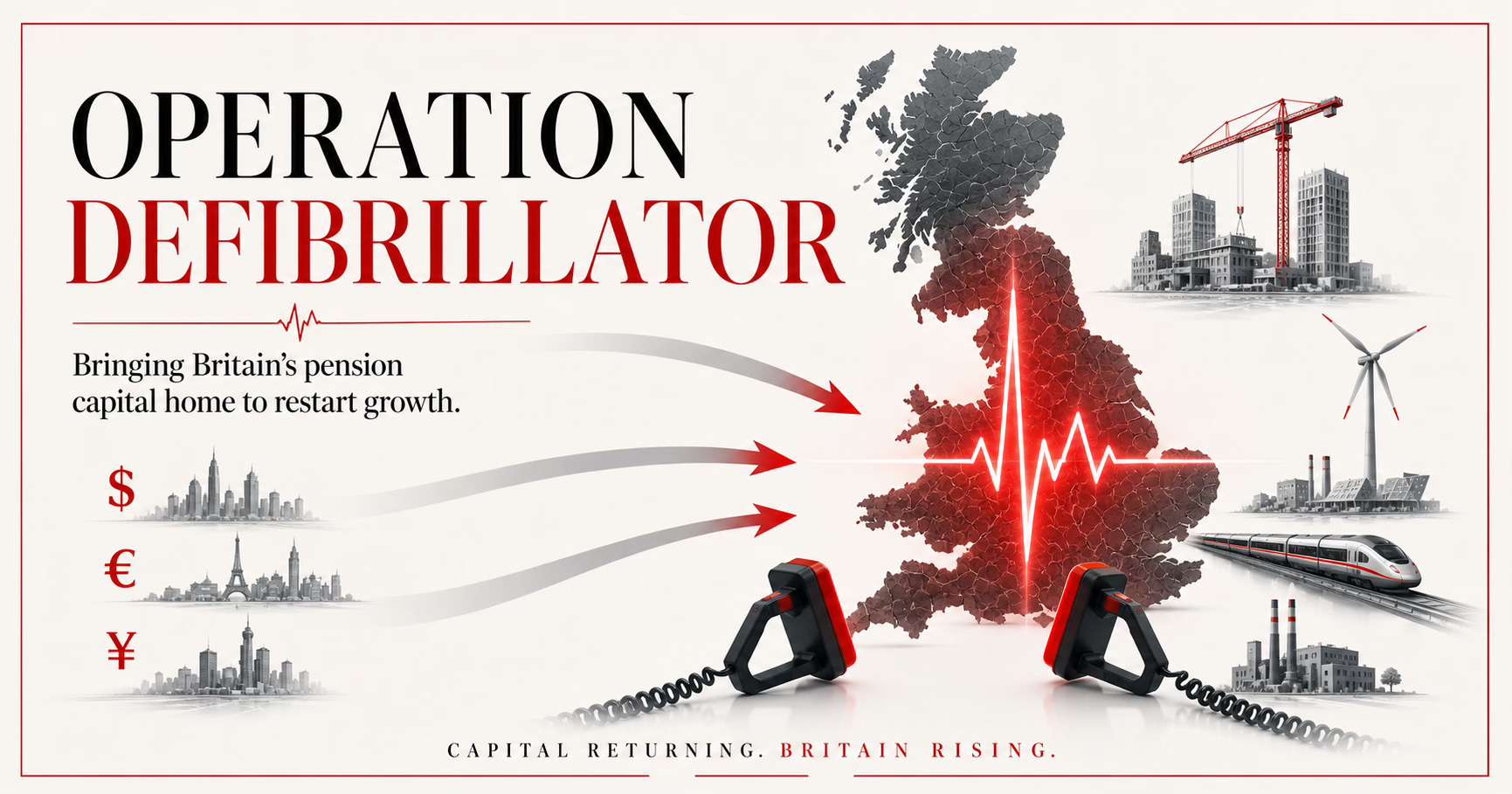
Britain has a problem that almost nobody discusses in plain terms.
Since 1997, the United Kingdom has invested less in productive capital than every other G7 country except Italy. According to the Office for National Statistics, UK whole economy investment sat at 19.3% of GDP in Q2 2025, the second-lowest in the G7. The G7 average is around 22%. Germany is at 22.8%. France is at 24.5%. Japan is at 25.6%.
A three percentage point gap, every year, for nearly thirty years, compounded against rising GDP, produces a cumulative shortfall of approximately £1.7 trillion. That is roughly the entire size of the UK economy in 2007. It is the value of every factory, machine, software platform, transport network, and research facility that should exist in this country and does not, because the capital went elsewhere.
It went into property.
While Germany was building BMW, Siemens, Bosch, and ThyssenKrupp, Britain was building a buy-to-let market. The result is now visible everywhere. We are about to become the only G7 country without primary steelmaking capacity. Our defence supply chains run through foreign ownership. We make zero advanced semiconductors. Our industrial energy costs are roughly twice Germany’s, which were already among the highest in the developed world.
This is not an accident. It is what happens when a country chooses, consistently, for forty years, to make property a more profitable investment than industry.
The conventional response to this diagnosis is some version of: that may all be true, but Britain cannot afford to fix it. The Treasury cannot find £100 billion a year in new spending. The state already runs a structural deficit. There is no political constituency for higher taxes. The capital simply does not exist.
That response is wrong. The capital exists. It belongs to British savers. It is currently sitting in their pension funds. And it is being deployed, with active subsidy from the British state, to fund the productive capacity of other countries.
This essay is about what happens when you redirect it.
The pension scandal nobody mentions
The United Kingdom has the second-largest pool of pension assets in the world. Roughly £3 trillion. Behind only the United States.
You might reasonably expect that a pool of capital that large, accumulated by British workers over decades for British retirements, would do meaningful work in the British economy. The reasonable expectation is wrong.
UK pension funds invest 4.4% of their assets in UK-listed equities. Twenty-five years ago that figure was over 50%. Today, on virtually every comparative metric, UK pensions allocate less to their domestic market than any comparable developed economy on earth.
For context, the same metric in other countries:
United States: roughly 60%
Japan: roughly 50%
Australia: roughly 45%
Italy: roughly 40%
France: roughly 26%
Canada: roughly 22%
United Kingdom: roughly 4%
This is not a marginal divergence. It is a categorical outlier. The capital that British workers save for retirement is currently being deployed to finance American technology firms, German industrial bonds, Japanese real estate, and emerging-market debt. Productive capacity built with British savings is overwhelmingly built outside Britain.
The picture gets worse. The British state subsidises pension contributions to the tune of approximately £70 billion a year in tax relief. This is one of the largest single subsidies in the British fiscal system. Its stated purpose is to encourage long-term saving and capital formation. Its actual effect, as a matter of arithmetic, is to subsidise British savers to fund foreign productive capacity. Every year, British taxpayers pay £70 billion to ensure that British pension funds can more efficiently invest in factories in Munich, semiconductors in Taiwan, and warehouses in Texas.
If you proposed this arrangement from scratch, in any country, you would be laughed out of the room. Yet it is the system Britain has run for two decades, and almost no political party has seriously proposed reforming it.
The British Industrial Investment Bank
The proposed reform has three parts, each addressing a different friction in the current system.
First, a state-backed development bank, the British Industrial Investment Bank, is established with the operational mandate of taking equity stakes in strategic UK industrial sectors. It functions analogously to the German KfW, which has operated since 1948 and underwrote much of the post-war German industrial recovery. The BIIB issues long-dated bonds at sovereign-plus-modest-premium yields, with maturities of twenty, thirty, and forty years. It does not lend like a commercial bank or invest like a venture fund. It takes patient equity positions in companies and sectors that no private investor in Britain can match on time horizon.
Second, the Land Value Tax mechanism we developed previously creates an off-ramp for retirees holding buy-to-let property as their pension vehicle. Under the LVT, buy-to-let returns become substantially lower. Retirees can hold the asset at the new lower margin, or sell into a transition window with a relief that allows them to redirect proceeds into one of three vehicles with pension-equivalent tax treatment: gilts, UK listed equities, or BIIB bonds.
Third, and this is the largest mechanism by capital scale, pension contribution tax relief is restructured. Full tax relief on contributions becomes contingent on a meaningful share of the pension portfolio flowing to UK productive assets. The threshold under serious reform would be 20% domestic allocation. Foreign assets remain entirely permissible; they simply no longer attract British state subsidy.
This third mechanism is the load-bearing one. The first two are catalysts; the third is the engine.
The scale of the reallocation
The numerical implications of the pension reform depend on the target domestic allocation. Two scenarios are useful.
Scenario A: French allocation (26% domestic)
Raising UK pension domestic allocation from 4.4% to 26% requires moving approximately £648 billion of existing pension assets from foreign to domestic deployment. Phased over five years to avoid disorderly market effects, that is roughly £130 billion per year of stock reallocation. Plus an ongoing flow effect of approximately £25 billion per year as new contributions allocate domestically at the higher rate.
Scenario B: Japanese allocation (50% domestic)
Raising UK pension domestic allocation to 50% requires moving approximately £1.37 trillion of existing pension assets. Phased over five years, that is £274 billion per year of stock reallocation, plus an ongoing flow effect of approximately £55 billion per year.
The Japanese scenario is the figure that makes the strategy genuinely transformative. It is also, in international terms, not radical. Japanese pension funds invest at roughly this level, and have done for decades. We are not proposing that Britain do something nobody has done. We are proposing that Britain stop being the global outlier on its own savings policy.
To put the £1.37 trillion stock reallocation in historical perspective, it is useful to compare it against the largest peacetime capital transfer in modern economic history.
The Marshall Plan, between 1948 and 1952, transferred $13.3 billion in nominal terms from the United States to sixteen recipient European countries. In 2024 prices, that is approximately $150 billion or £120 billion. As a share of US GDP at the time, the Marshall Plan was about 5%, and as a share of the recipient countries’ combined GDP, it was about 10.5%. The Banque de France’s 2021 retrospective treats this as the meaningful comparative metric: the Marshall Plan was a 10.5%-of-GDP capital transfer over four years.
The UK pension reallocation under the Japanese scenario is a £1.37 trillion stock shift in a £2.5 trillion economy. That is 54.7% of GDP, deployed over five years, plus an ongoing flow effect for thirty years that adds another £1.4 trillion over time.
In nominal pound terms, the UK pension reallocation is approximately 11x the size of the Marshall Plan. Measured against the recipient economy’s GDP, it is approximately 5.2x larger.
This is, in straightforward economic terms, one of the largest deliberate redirections of capital in human history.
There is, however, a critical asymmetry that needs to be stated clearly. The Marshall Plan was an external transfer. The United States gave Europe the money to rebuild. The UK pension reallocation is internal. Britain already has the capital. It is sitting in our pension funds. The reform redirects it homeward.
This asymmetry is not cosmetic. The Marshall Plan required sixteen European countries to receive a once-in-history act of American generosity. The UK pension reallocation requires no foreign generosity at all. It requires only that the British state stop subsidising £70 billion a year of British savings flowing into foreign productive capacity. The Treasury cost of the reform is essentially zero. Possibly positive, since some of the £70 billion in current tax relief is now redirected into a smaller, more conditional version of the same incentive.
This is what makes the strategy politically deliverable in a way that, say, a £1.4 trillion government investment programme would not be. The capital exists. The fiscal cost is negligible. The only thing required is the political courage to redirect tax relief from foreign capital export to domestic capital formation.
The Dynamic Model
A static accounting exercise, moving £1.37 trillion from one column to another, does not capture what actually happens to an economy when capital reallocation of this magnitude is combined with appropriate supporting policy. The standard textbook treatment of investment as additive arithmetic understates the effect substantially.
The full model incorporates four dynamics.
First, pension reallocation produces a stock shift and an ongoing flow effect. The stock shift is the existing £1.37 trillion that moves from foreign to domestic assets, phased over five years. The ongoing flow effect is the difference in domestic allocation rate applied to new pension contributions, which under the Japanese scenario adds approximately £55 billion per year of additional domestic capital formation in perpetuity. This is the simplest dynamic and the only one a static model captures.
Second, the energy cost differential drives a private investment response. Under the BIIB energy strategy, small modular nuclear reactors, offshore wind manufacturing capacity, grid-scale battery storage, and the decoupling of UK electricity prices from spot gas markets, UK industrial electricity prices fall to approximately 40% below current German levels by year ten. This is a reversal of the current asymmetry. Empirical research on the German manufacturing boom of the 2000s suggests that each 10% real cost advantage on industrial energy generates approximately 1 percentage point of additional private business investment as a share of GDP. A 40% cost advantage therefore generates approximately 4 percentage points of GDP in additional private investment crowd-in, phased in over years 5–10 as the energy infrastructure comes online. At UK GDP scale this is approximately £200 billion per year of additional private investment by year ten, larger than the public BIIB allocation.
Third, capital compounding produces total factor productivity gains. Endogenous growth theory, particularly the Aghion-Howitt and Romer literatures, establishes that capital invested in research-intensive sectors generates spillover productivity gains across the broader economy. A semiconductor fab in Cambridge raises productivity for every chip-using industry. A new green steel plant lowers input costs for every downstream manufacturer. A defence munitions facility creates skilled engineering jobs whose productivity transfers to civilian applications.
The model parameterises this conservatively. Approximately 30% of new BIIB capital is allocated to strategic sectors with high spillover potential, semiconductors, defence R&D, green steel, energy systems. Once cumulative strategic capital exceeds approximately £200 billion (reached around year six or seven), TFP begins growing at 0.3 to 0.5 percentage points per year above baseline. This is consistent with empirical estimates from the Aghion et al. literature on R&D and productivity, which find approximately 0.5% TFP gain per 1 percentage point of GDP in research investment over a ten-year horizon.
Fourth, the wage-pension feedback loop closes the system. Higher TFP growth produces higher real wages. Higher real wages produce higher pension contributions. Higher pension contributions, allocated at the new domestic threshold, produce higher domestic capital formation. This is the dynamic that makes the system genuinely self-reinforcing rather than asymptotic. Under sustained TFP gains of 0.5pp above baseline, the UK pension pool grows at approximately 4.5% real annually rather than the baseline 3%. By 2055 the pool reaches approximately £8.5 trillion in 2024 prices, which is itself a substantial component of UK national wealth.
The output of the model
Running these dynamics together produces a trajectory that diverges sharply from the baseline.
Under no reform, the UK loses ground to Germany every year. By 2055 the UK has approximately £7.4 trillion in productive capital stock against Germany’s £11.1 trillion. The gap widens from £1.5 trillion today to £3.8 trillion. Britain becomes a smaller share of the European economy, with progressively more of its high-value-added industrial capacity offshored to Germany, France, and the United States. This is, broadly, the trajectory the country is currently on.
Under the Japanese-allocation scenario combined with the energy and compounding dynamics described above, the UK overtakes Germany on productive capital stock in 2044. Nineteen years from now. By 2055 the UK has approximately £11.5 trillion in productive capital, against Germany’s £9.3 trillion. The relative position has reversed.
The UK GDP trajectory tells the same story in different units. UK real GDP in 2025 is approximately £2.5 trillion. Under no reform, it grows to approximately £3.4 trillion by 2044, broadly tracking Germany. Under the reform path, it reaches approximately £3.8 trillion by 2044, passing Germany, ahead of France, ahead of every European economy except the EU-27 aggregate.
The difference between the two trajectories, £428 billion of additional GDP by 2044, is roughly the entire current GDP of Belgium. The policy effect, by 2044, is “the UK has created an additional Belgium worth of economy.”
By 2055 the divergence is wider still. Reform path: £4.9 trillion. No reform: £3.9 trillion. Difference: roughly £1 trillion, which is roughly the size of Indonesia today.
These figures are real, in 2024 prices. The nominal figures, after twenty years of cumulative inflation at 2% annually, would be approximately 50% larger. UK GDP at 2044 in nominal pounds reaches approximately £5.6 trillion, which is the figure that would appear in newspaper headlines at the time. Whether one prefers the real or nominal version is a matter of presentation; the underlying economic transformation is the same.
The defence implications of this trajectory are worth noting in passing. The British Industrial Investment Bank framework links to a 3.1% of GDP target for defence spending. At 2044 GDP scale, that is approximately £117 billion per year in real terms, or £175 billion in nominal pounds at the time. This is double today’s UK figure, larger than current Russian military spending, and larger than today’s combined French and German budgets. Because the BIIB has spent the previous decade building the domestic Tier 2 defence supply chain, approximately 70 to 80% of this spending stays in the UK economy. The result is roughly £85 to £95 billion per year of domestic defence orders, paying British engineers, in British factories, supplying a British defence base that does not depend on Berlin or Washington signing the export licence.
Why the model produces such different results from a static calculation
It is worth pausing on why this trajectory looks so different from the static accounting version.
A naive calculation would treat the pension reallocation as a one-time stock shift, add it to the baseline UK investment rate, and conclude that the UK closes the flow gap with Germany during the phase-in period and then runs at roughly the same investment rate afterwards. On this calculation the stock gap never closes; we simply stop falling further behind.
That calculation is wrong because it ignores the economic dynamics that the reallocation triggers. The pension shift is not the only mechanism, it is the trigger. Once it happens, three additional effects activate.
Cheap energy makes private investment economic at scales that are currently uneconomic. A factory that loses money at £200 per megawatt-hour is profitable at £80. Multiply that across thousands of investment decisions made annually by private firms, and the private response is larger than the public investment that triggered it. This is not speculation; it is exactly the dynamic that built German industry between 1960 and 2000, when German industrial energy was structurally cheaper than European competitors.
Strategic capital generates spillover productivity gains. This is the most established result in modern growth theory. Capital invested in research, semiconductors, defence systems, and energy infrastructure raises the productivity of the broader economy by lowering input costs, improving labour skills, and spreading technical knowledge across firms. The model parameterises this conservatively, at 0.5 percentage points of TFP. This is below the empirical estimates from the Korean and Japanese industrial transformations, both of which generated TFP growth substantially above 1 percentage point per year over their twenty-year ascent phases.
Wage growth feeds back into the pension pool. The simplest dynamic of the four. Higher TFP produces higher wages, which produce higher pension contributions, which produce a larger pool to allocate. The pool grows faster than the baseline, and its absolute size by 2055 is approximately £3 trillion larger than under the baseline assumption.
The cumulative effect of these dynamics is that the UK does not merely close the flow gap, it reverses it, sustains the reversal for two decades, and accumulates a productive capital lead over Germany of approximately £2.2 trillion by 2055.
This is not utopian modelling. It is the same trajectory that South Korea ran from 1965 to 1995, and Japan ran from 1955 to 1985. Both cases involved the same three ingredients: patient capital reallocation, sustained energy and infrastructure cost advantages, and wage-driven savings expansion. The model is not reaching for a new theory. It is describing the East Asian developmental state mechanism applied to Britain.
The honest caveats
A model of this kind makes several assumptions that need to be examined honestly.
Energy delivery is the largest execution risk. Achieving 40% lower industrial electricity prices than Germany requires successful delivery of small modular nuclear reactor programmes, offshore wind manufacturing capacity, grid-scale storage, and the legal and regulatory work of decoupling UK power prices from spot gas markets. SMR programmes have a track record of cost overruns and delays. If the energy advantage is only 20% rather than 40%, the private investment crowd-in is roughly halved and the timeline shifts five to seven years later.
Compounding requires execution discipline on strategic capital allocation. The TFP gain depends on BIIB capital flowing into genuinely high-spillover sectors, semiconductors, advanced materials, defence R&D, green steel innovation, rather than into preservation of existing industries or politically preferred but economically marginal projects. If the BIIB ends up funding zombie incumbents or politically motivated regional subsidies, the productivity boost is much smaller. Execution discipline matters enormously, and the governance design of the BIIB is therefore critical to the trajectory.
Germany is assumed to grow slowly at 0.5% per year. This reflects current Bundesbank and DIW analysis suggesting that German net investment has been close to zero since 2019. Their average factory is 25 years old. Their automotive sector is in genuine structural difficulty. Their political system is currently incapable of resolving the Schuldenbremse fiscal constraint. If Germany has a successful industrial revival, perhaps under a CDU-led government that reforms the debt brake and accelerates the energy transition, Germany could grow at 1.5% per year. In that scenario the UK overtake happens five to eight years later than 2044. The strategic outcome is the same; the timing is later.
Political durability across multiple parliaments is the largest single risk. The model assumes the pension reallocation, the energy strategy, and the BIIB all survive successive governments for two decades. This is a heroic political assumption. It would require the reforms to become structurally embedded, through institutional design, broad-based political consensus, or both, within their first five years. The history of British post-war industrial strategy is not encouraging on this point.
Inflation, exchange rates, and global market conditions are not modelled. The figures are in real 2024 prices and assume orderly capital markets. A major global recession, a sterling crisis, or a sustained inflationary shock would all complicate the trajectory. None of these are reasons to disbelieve the underlying mechanism; they are reasons to expect the actual path to be bumpier than the model suggests.
What the trajectory means
Strip out the technical economics for a moment and consider what the figures actually describe.
In 2044, on this path, Britain has overtaken Germany on productive capital stock. UK GDP has reached approximately £3.8 trillion in real terms. The UK has the largest economy in Europe behind only the EU-27 aggregate, with a per capita income approaching £53,000. UK industrial electricity is the cheapest among major developed economies. Britain has primary steelmaking capacity, a domestic semiconductor industry, a Tier 2 defence supply chain, and offshore wind manufacturing capability. The UK pension pool has grown to approximately £6 trillion, and 50% of it is invested domestically, financing the next round of capital formation.
By 2055 the trajectory has compounded further. UK GDP reaches roughly £4.9 trillion. The capital stock lead over Germany has grown to £2.2 trillion. Britain has become, on the world stage, what it used to be in the nineteenth century: a country with a meaningful industrial base, a globally competitive technological capacity, and the productive depth to support its political ambitions.
This is not a fantasy. It is the trajectory implied by the redirection of British savings, capital that already exists, that already belongs to British workers, that is currently being subsidised by the British state to fund foreign productive capacity. The reform requires no fiscal expansion, no foreign assistance, no novel monetary policy. It requires only that Britain stop being the global outlier on its own savings policy.
There is an instructive comparison with the post-war Golden Age. Between 1948 and 1973, the UK economy grew at an average of approximately 2.5% per year in real terms. Productive capital deepened. Real wages rose substantially. The country built a generation of industrial capacity that, while subsequently degraded, supported the broader population’s living standards in a way no period since has matched. The Marshall Plan was a meaningful catalyst for the European version of this period, but the dominant mechanism was internal: high domestic savings, sustained capital investment, and patient reinvestment of productive surplus.
Operation Defibrillator is, in essence, a proposal to recreate those conditions in modern Britain. Same mechanism. Different starting point. We have the capital. We have the savings infrastructure. We have an existing pool of pension assets that is the second-largest in the world. What we lack is the policy framework that ensures the capital does productive work in the country it belongs to.
The diagnosis is forty years old. The mechanism is well-understood. The capital is already in the room. The only remaining question is whether Britain has the political courage to write the policy that connects them.
Methodology notes
For readers interested in the technical detail.
Capital stock projection model. Standard perpetual inventory method with annual depreciation rate of 6% on productive (non-dwelling) capital, consistent with OECD assumptions. Initial capital stocks: UK £2.0 trillion, Germany £3.5 trillion, derived from ONS Blue Book and Destatis equivalents. UK productive GFCF rate held at 15.1% of GDP in baseline (78% of total GFCF, stripping out residential investment). Germany at 17.1% (75% of total GFCF). German GDP growth assumed at 0.5% per year reflecting current stagnation. UK GDP growth at 1.5% baseline, rising to 2.5% steady-state once TFP boost is fully active.
Pension reallocation. Stock shift = (target allocation – 4.4%) × £3 trillion pool, phased linearly over 5 years. Ongoing flow effect = 4% annual contribution growth × (target – 4.4%) × pool size, applied from year 6 onwards. Capital efficiency factor of 0.7 applied to pension reallocations to reflect partial leakage to existing-asset purchases, share buybacks, and consumption rather than new productive capital formation. The BIIB bond mechanism is designed to maximise the share that becomes new capital formation, but a 30% leakage assumption is conservative.
Energy crowd-in. 4 percentage points of GDP additional private investment at full effect, ramped linearly over years 5 to 10. Calibration based on Bachmann et al. and similar studies of European industrial energy cost differentials in the 2000s. The 1pp-of-GDP-per-10%-cost-advantage relationship is empirically supported but bounded; the model caps the effect at 4pp.
TFP compounding. Threshold-based activation. Strategic capital fraction set at 30% of new BIIB capital. Once cumulative strategic capital exceeds £200 billion, TFP begins growing at 0.5pp above baseline, ramped over a £300 billion accumulation window. TFP gain doubles into GDP growth (standard accounting).
Wage-pension feedback. Pension pool growth = 3% baseline + 1.5 × TFP boost. The 1.5 multiplier reflects the partial pass-through of TFP gains to wages, and from wages to pension contributions.
Marshall Plan comparison. Total Marshall Plan figure of $13.3 billion nominal (1948-1952) is widely cited. CPI-adjusted to 2024 is approximately $150 billion (Bureau of Labor Statistics) or £120 billion at current FX. As share of recipient GDP combined, 10.5% (Banque de France 2021 retrospective). UK pension stock shift compared at £1.37 trillion against UK GDP of £2.5 trillion, yielding 54.7% of GDP. Ratio: 5.2x in GDP-relative terms, 11x in nominal 2024 absolute terms.
All numerical figures use 2024 real prices unless otherwise stated. Code for the model is available on request.
This essay is part of a series on UK industrial policy and the Housing Theory of Everything framework. Previous post: “The Land Value Tax: Implementation Without Tears.” Companion video: “The British Industrial Investment Bank”, available on TikTok at @henryfudgeofficial.
If this analysis was useful, consider subscribing. The work continues.
Amen! I’ve been preaching this for years. A few tweaks I’d suggest:
Do it to the trillions in UK insurance funds, too.
Scrap tax relief on pension contributions altogether. It is immoral to tax poor workers to give tax relief to people with enough excess to pad their pensions.
We need mechanisms to ensure these trillions flow solely into creating new domestic assets. Off-ramping into UK listed equities will create a massive unproductive stock market bubble.
The white pill I didn't know I was looking for