
Most Boring Martyr
The leader a democracy needs to fix its deepest problems is the one it is least able to choose and keep.

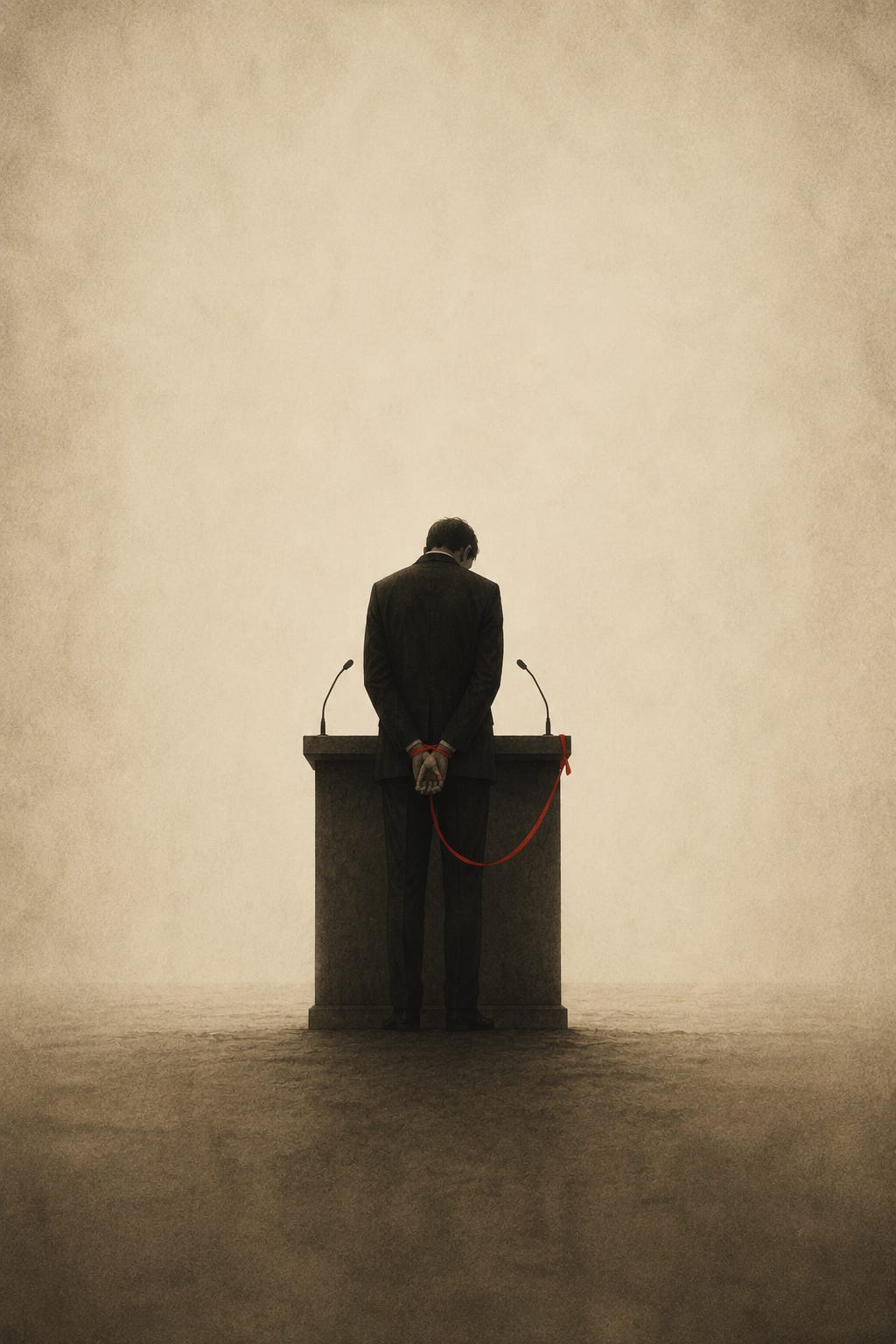
Consider a leader who inherits a problem with a known cure. Not a contested cure, not a matter of taste dressed as economics, but a structural fault whose mechanism is understood and whose repair can be specified. Suppose the repair takes the better part of a decade. Suppose it imposes its costs early and delivers its benefits late, and that the costs fall on people who can see them clearly while the benefits accrue to people who do not yet know they are owed anything.
Now ask what happens to that leader’s popularity over the life of the repair.
The answer is the uncomfortable part, and it is worth stating before anything else, because everything that follows is an attempt to take it seriously rather than to wish it away. The leader is least popular at the moment the repair is working best. This is not the ordinary story of delayed gratification, the one where you suffer now and are thanked later. It is sharper than that. The phase in which the mechanism is doing exactly what it is supposed to do, the years in which the fault is closing and the new structure is taking the strain, is by construction the phase that shows only cost. There is nothing to point at. The benefits are real and they are coming, but they are not yet visible, and the costs are both visible and present. So the correlation between the reform’s health and the reformer’s standing is not merely weak. It is inverted. The better it goes, the worse they look.
There is a proverb about old men planting trees in whose shade they will never sit. It is a fine sentiment and it is not what this essay is about, because the proverb describes a generous choice freely made, and what we are describing is a trap. The tree-planter is admired. Our leader is despised, and despised most in the season the saplings take root.
The question this essay tries to answer is why a democracy would ever produce such a leader, and having produced one, why it would keep them. The answer turns out to be discouraging in a specific and useful way. But the route to it runs first through a problem that economics has already solved once, in a domain we no longer think of as remarkable at all.
The enemy is not the opposition
Begin with the nature of the reform, because the nature of the reform determines the nature of the failure.
A certain kind of policy can be delivered by force. You identify the lever, you pull it hard, you absorb the resulting pain, and the thing is done. The pain is the price and the price is paid up front. Reforms of this kind reward decisiveness, because decisiveness is precisely the input they require, and a leader who hesitates merely prolongs the agony without changing the outcome.
The reform we are concerned with is not of this kind. It is a reform of a system that feeds back on itself, where the variable you are trying to move is also the variable that determines how much room you have to move it. Acting too fast does not simply hurt more; it breaks the mechanism you are relying on to absorb the adjustment. These reforms do not reward force. They reward sequencing, pacing, and the discipline to move slowly while under maximum pressure to do the opposite. You cannot will a balancing act. You can only will a shove, and a shove is the one thing the balancing act cannot survive.
For a reform of this second kind, the binding threat is not the opposition party. The opposition was always going to oppose; that is free, and it is priced in from the first day. The threat is the future decision to soften. It is the moment, two or three years in, when the costs have landed and the benefits have not yet arrived and the polling has cratered, and someone, very possibly the reformer’s own side, very possibly the reformer, does the arithmetic and concludes that the gradient could be eased just a little to relieve the pressure. The reform does not die at the ballot box against the other party. It dies at its author’s own hand, in private, for entirely understandable reasons.
Economists have a name for this. They call it time inconsistency, and the canonical statement of it is now nearly fifty years old. In 1977 Finn Kydland and Edward Prescott showed that a policy which is optimal when announced can cease to be optimal once the moment arrives to carry it out, not because circumstances have changed and not because the policymaker was lying, but because the incentives that hold at the moment of action differ from the incentives that held at the moment of promise. The optimal long path is, in the technical sense, not credible. Rational observers know that the policymaker will be tempted to defect when the costs come due, and so they do not believe the promise, and the promise unravels in advance. The work was important enough to win the Nobel in 2004, and Robert Barro and David Gordon extended it through the 1980s into a full account of why discretionary authority, however well intentioned, struggles to commit.
This is the reformer’s true adversary. Not the other party, but their own future self, acting rationally, under pressure, with every reason to flinch.
We have solved this before
Here is the part worth dwelling on, because it is both the source of the solution and the source of the legitimacy the solution needs.
Democracies have already faced this exact problem, in one of the most consequential areas of economic policy, and they solved it. The area is monetary policy. For most of the twentieth century, the setting of interest rates sat in the hands of elected governments, and elected governments faced a textbook time-inconsistency problem. The optimal long-run policy was to keep inflation low and stable. But in any given month, with an election approaching or a recession biting, the government faced a powerful temptation to loosen, to buy a little growth now against a little inflation later. Everyone understood this temptation, which is precisely why low inflation was not credible. The expectation of future loosening fed into wages and prices in the present, and the economy inherited the inflation without even the temporary benefit of the loosening.
The solution democracies adopted was not to exhort governments to behave. It was to remove the lever from the hands that could not be trusted not to abuse it. Central bank independence is, stripped of its technical apparatus, a pre-commitment device. The state binds itself by handing a specific power to an insulated institution with a narrow mandate and a long horizon, an institution structurally protected from the monthly temptation that would otherwise govern the decision. Kenneth Rogoff gave the formal version of this in 1985, the case for delegating monetary policy to a central banker deliberately more averse to inflation than the median voter, precisely so that the institution would hold the line the public, in the moment, would not. In Britain this was done in 1997, when operational control of interest rates passed to the Bank of England, and it is now so thoroughly normal that its radicalism has been forgotten.
Notice what kind of act this was. It was not a suspension of democracy. It was a democratic decision to constrain future democratic decisions, made in the open, ratified by the ordinary processes, and broadly regarded as legitimate ever since. The electorate did not lose its sovereignty. It exercised that sovereignty to tie its own hands, having understood that its hands, left free, would do something it did not, on reflection, want done.
This is the precedent. The reform we began with faces the same structural problem that monetary policy faced, the problem of a long optimal path undermined by the short-run temptation to defect, and the instrument that solved it there is available here.
Extend the instrument
The proposal, then, is not heroism. It is plumbing. If the reform dies from the future discretionary decision to soften, the answer is to remove the discretion. You do not ask a leader to hold the line by character for a decade. You build the line into something that does not depend on character.
Concretely, this means writing the reform as a set of automatic mechanisms rather than a series of choices. Escalators that increase on a fixed schedule or on the achievement of a defined milestone, rather than at a minister’s discretion. Institutions with operational independence and multi-year funding commitments that a successor cannot quietly starve. Mandates whose design is fixed in statute, so that softening the gradient requires not a private decision over a weekend but primary legislation conducted in daylight. The aim is to convert the act of flinching from something easy and invisible into something hard and exposed. You cannot prevent a future government from reversing course. You can make reversing course expensive, slow, and public, which is often the difference between a reform that survives and one that does not.
Political philosophy has been circling this idea for far longer than economics. Edmund Burke, addressing the electors of Bristol in 1774, drew the distinction between a representative who is a mere delegate, bound to transmit the immediate wishes of those who sent him, and a representative who is a trustee, owing his constituents his judgment rather than his obedience. The trustee model is precisely a model of legitimate precommitment: the representative is authorised, within bounds, to bind the present to a judgment the present might not share. Jon Elster gave the modern image, in Ulysses and the Sirens and later in Ulysses Unbound. Ulysses, knowing that his future self will be overwhelmed by the song and will beg to be released, has himself bound to the mast in advance and orders the crew to ignore his pleas. The binding is not a defeat of his will. It is the fullest expression of it, the considered self protecting its purpose against the self it knows it will temporarily become. And James Buchanan, in The Calculus of Consent with Gordon Tullock in 1962, built an entire tradition on the distinction between the constitutional level, where a society sets the rules that will bind it, and the ordinary level, where it acts within them. Constitutions are nothing but precommitment written large. A democracy that binds itself is not a democracy in retreat. It is a democracy doing the most characteristic thing it does.
This is also the answer to the first objection the proposal will meet, which is that it amounts to insulating economic policy from democratic accountability, a technocratic power grab dressed in the language of prudence. The objection has force, and it deserves a serious answer rather than a dismissal, which we will come to. But the headline reply is simply the precedent. Central bank independence is the objection’s own counterexample. It was precommitment, it was democratic, and the people who worry most about technocratic insulation generally do not propose to abolish it. The question is not whether democracies may bind themselves. They plainly may, and do. The question is which problems warrant it, and on what terms.
The institution still needs a person first
Central bank independence was, in a sense, a single act. The lever was handed over once, the institution was stood up, and the binding held thereafter without requiring any particular individual to suffer for it year after year. The reform we are concerned with is not like that, because it cannot be locked in a single act. The locks themselves take years to build. Statutes must be passed, institutions stood up and capitalised, escalators legislated and survive their first legal challenge. Through that whole window, before the binding is complete, the reform depends on a person holding the gradient by will. The plumbing is the destination. Someone still has to survive the journey to it.
So the martyr is unavoidable after all, but their job is not what it first appears. It is tempting to imagine the role as endurance, a matter of gritting one’s teeth and holding firm against the mob for a decade. It is not. No individual will hold a falling popularity for ten years by force of temperament, the political market will remove them long before the decade is out. The real job is stranger and more self-effacing. The leader must spend their peak political capital, the large majority and the early goodwill, not on the visible reform but on building the locks that will make themselves unnecessary. They must use their strongest position to legislate their own future irrelevance to the process, so that by the time they are hated enough to be removed, the reform no longer depends on them.
This is a genuinely unusual demand. It asks a leader to spend capital on constraints rather than on actions, and constraints deliver no electoral credit whatsoever, because their entire purpose is to bind future governments, including the leader’s own. You do not cut a ribbon on a statutory escalator. You win no applause for a funding commitment that ties your successor’s hands and, in passing, your own. The leader is being asked to convert their popularity into machinery that will run after they are gone and for which they will receive no thanks while they remain. Almost nothing in political life rewards this. The incentive is to spend capital on the building, where the credit is, not on the locks, where the credit is not. The leader who gets this right is, by the standard of their own career, behaving irrationally.
The strongman wears the same costume
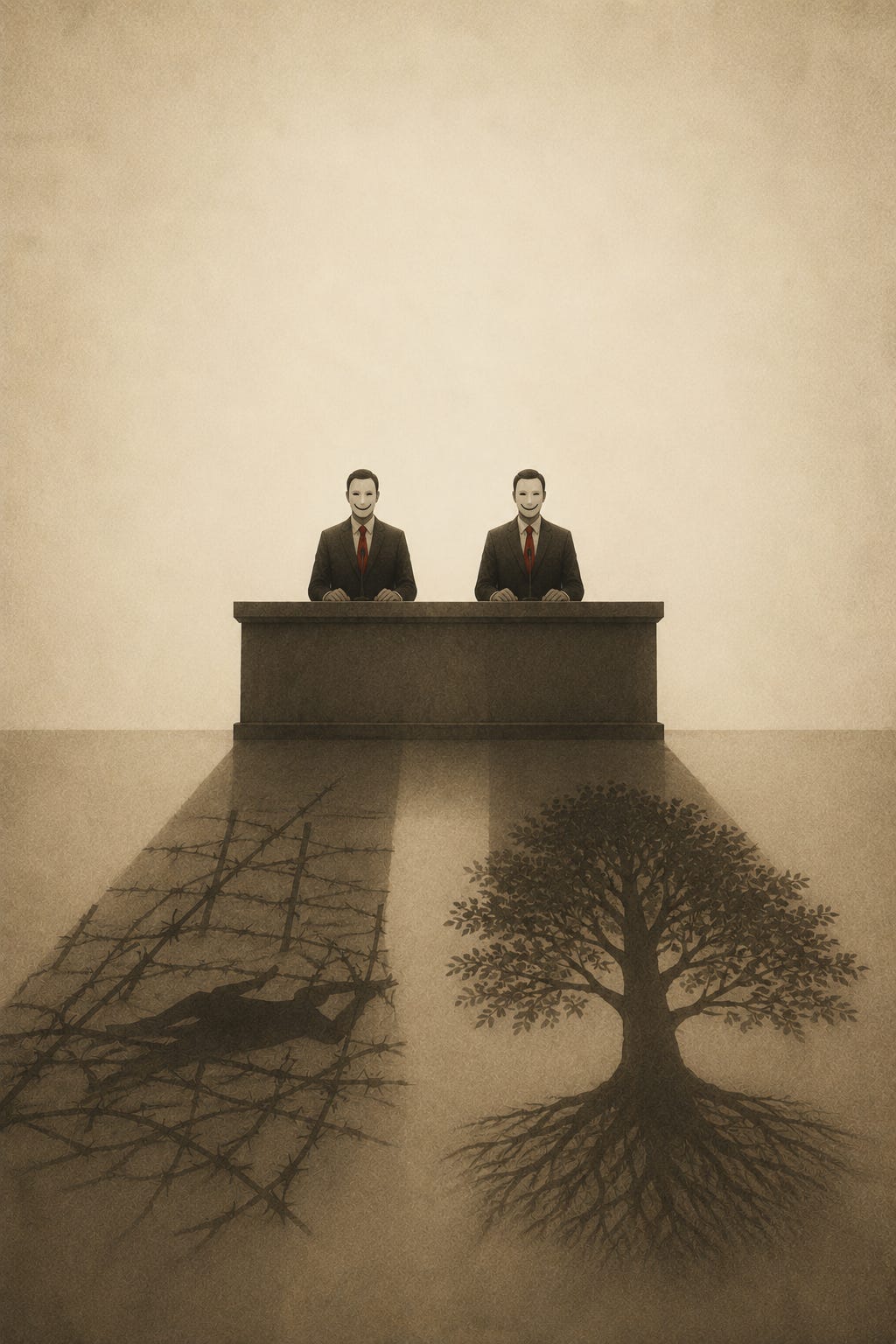
Now the danger, stated plainly, because the proposal is one short step from something ugly and the step must be refused out loud.
Everything said so far can be spoken by a tyrant. “I am hated because I am right.” “The people cannot see the benefits yet.” “History will vindicate me.” “Weak leaders flinch; I will hold the line.” These are not the words of the reformer we have been describing. They are the words of every authoritarian who ever justified the accumulation of unaccountable power, and they are, word for word, indistinguishable from the reformer’s own. There is no rhetorical test that separates the two. Both ask for patience. Both promise vindication after their tenure. Both are hated now and both insist the hatred is the proof. The strongman and the gardener give the same speech.
This is the heart of the second objection, the one that comes from a different direction, that this is simply a vindication of the hard man, the decisive leader who ignores the crowd and forces through what he knows to be right. The answer is that it is the opposite, and the reason it is the opposite is the only thing that distinguishes the two figures at all. It is not their words, their conviction, or their suffering, all of which they share. It is the plumbing.
The genuine reformer builds constraints that bind themselves. The strongman accumulates discretion that frees himself. The reformer legislates the automatic escalator so that even they cannot soften it later, and hands power to an institution they cannot subsequently command. The strongman takes emergency powers, suspends the inconvenient procedure, and explains that the gravity of the moment requires that his own hands be untied rather than bound. Same justification, opposite mechanism. One is trying to make the reform survive without them. The other is trying to make himself indispensable to it. Watch the hands, not the mouth. The reformer is the one walking out of office weaker than they entered, having given their power away into structures. The strongman is the one who has more power at the end than at the beginning, and a reason for all of it.
This is why the structural test is not a footnote but the spine of the whole argument. Strip it out and what remains really is strongman apologetics with a better vocabulary. With it, the position is precise, a democracy may bind itself, and the leader who binds the state including themselves is doing something categorically different from the leader who frees themselves to act. The test is hard to apply in the moment, which is a real limitation we will not pretend away. But it is the only test there is, and in retrospect it is decisive.
The public is not stupid
There remains the most tempting misreading of all, and it is the one this essay most wants to refuse. It would be easy to conclude that the problem is the public: that voters are short-sighted, that they demand visible action and instant results, that they cannot be trusted to leave a wise leader alone long enough to do the slow work, and that the tragedy is the tragedy of brilliance thwarted by a foolish crowd.
This is wrong, and it is wrong in a way that matters, because the public’s behaviour is not foolish. It is rational.
Recall the structural test from the previous section. The genuine reformer and the strongman are indistinguishable in real time; only the plumbing tells them apart, and the plumbing is technical, slow to reveal itself, and easy to obscure. Now add the base rate. For every leader who is hated because they are right and slow and building something real, there are many who are hated because they are simply wrong, or vain, or destructive, and who reach for the identical script of misunderstood vindication to explain away their unpopularity. The misunderstood visionary is real but rare. The person who merely claims to be one is common. And there is no reliable test, available to a voter in the present, that distinguishes them, because they present identically and the distinguishing feature reveals itself only over the horizon the voter is being asked to wait through.
Under those conditions, skepticism is not stupidity. It is a sound heuristic. A public that demanded patience and trust from every leader who claimed to need it would be fleeced constantly, because the claim is cheap and the script is universal. A public that withholds its trust, that demands visible evidence, that treats “wait and you will see” as the warning sign it usually is, will be wrong about the occasional genuine reformer and right about the many imitations. That is not a failure of the demos. It is the demos doing the only sensible thing available to it given the information it has.
So the tragedy is symmetric, and this is the shape of it. It is not a wise leader undone by a foolish crowd. It is that the correct reform is forced to wear the same face as a hundred incorrect ones, and the crowd is reasonable to distrust the face. The leader who is right cannot prove they are right, because the proof lies past the end of their tenure, and the only people who could be asked to take it on faith are precisely the people who would be exploited if they took such things on faith. Neither side is the villain. The information structure is the villain, and information structures do not photograph well, which is part of why this is so rarely understood.
It is worth being honest about how far the proposed solution goes, because it does not go all the way. Precommitment in a democracy is always soft. A successor can repeal a statute; locks slow defection, they do not prevent it. The central bank precedent itself is more contested than its normalisation suggests, sharpened by the financial crisis and again by the inflation that followed the pandemic, and the objection that unelected institutions wield power with real and uneven distributional consequences is not answered by pointing out that the arrangement is popular. Extending precommitment from monetary policy, where a single clean mandate is plausible, to the overtly distributional terrain of structural reform is harder, not easier, and anyone who claims otherwise is selling something. The proposal buys the reformer time and raises the cost of the flinch. It does not deliver permanence, and it should not be sold as if it did.
The diagnostician’s only act
Which returns us, by a longer road than expected, to the leader we began with, and to the discouraging precision of the answer.
We can now specify the figure exactly. They need a large majority, not to force the reform through against opposition, but to buy time against their own side, to absorb the loss of the nervous third of their party when the polling collapses and still hold the line. They need the temperament to be hated for a full cycle without flinching at the year-two trough. They need the self-effacement to spend their peak capital on locks rather than on the building, legislating machinery that will outlast them and earn them nothing. They need to bind themselves so visibly and so structurally that no one can mistake them for the strongman whose every word they share. They need to do all of this while the public, rationally, distrusts them, and while no available evidence can vindicate them inside the window in which they hold office.
The specification is complete. It is also a specification of a person the political configuration is built not to produce. The same arithmetic that tells us what such a leader would have to do tells us why the system rewards the alternatives instead, the strongman who forces the reform and breaks the mechanism, or the softener who eases the gradient and is caught halfway, with the costs incurred and the benefits forfeited. The configuration wants a strongman. The reform needs a gardener. And at the moment of choosing, the two are indistinguishable, which means the configuration will reliably choose the one it can recognise, which is the wrong one.
This is the part the diagnostician finds it hardest to say, because it implicates the act of diagnosis itself. To write all of this down, carefully, is to demonstrate that the cure was never the difficult thing to identify. The mechanism is legible. The repair is specifiable. The sequence is designable, the locks are buildable, the precedent exists and is honoured. None of that was ever the obstacle. The obstacle is that the configuration which could deliver the cure requires a leader to win a majority in order to spend it making themselves unnecessary, to court the country’s hatred in proportion to their success, and to be unprovable in their own lifetime, and the political market does not select for that and cannot be made to.
Naming the leader who could hold the line is not the same as the line being held. The writing-down changes nothing about the configuration, it only describes it accurately, which is the one thing the diagnostician is actually able to do.
There is a temptation, at the end of an argument like this, to reach for a note of hope, some account of how the gardener might yet be found. The honest version withholds it. The gardener is not found. The gardener is described, in full and correct detail, by someone who can see precisely why the description will not be filled. That is not despair. It is the exact shape of the gap between knowing what to do and its being done, and mapping that gap with precision is the whole of what a diagnosis can offer. The cure was always the easy part. Knowing that is the hard part, and it is the only part the diagnostician gets to keep.
There are some good ideas here.
Thank you for another very eloquent study into how change might be brought about to circumvent party politics. The last time the UK indulged in major changes was the disastrous Brexit decision mistakenly based on a simple majority of those bothering to exercise their voting rights in a national referendum. That managed to cross party lines and succeeded to the point that no government has yet tried to reverse it. The question now remains to determine how we might completely change the tax system responsible for creating our deepening asset black hole. If a single party makes such a change of course it would almost certainly be reversed by the next one in control, or substantially watered down to suit their pursuit of voters at an election. It seems to me that we will need the equivalent of a Royal Commission Report in unbiased form, followed by another referendum requiring a majority of the registered electorate. As you say, the electoral majority are not stupid..l The snag is that such a process might take 10 to 15 years with three elections during the period and ample chance for influencers to spread misdirection at every stage - with or without signage on the side of a campaign coach. Frankly, I do not know the answer but, I do know that the UK would stand to benefit whether or not the media influencers peddle every potential disadvantage they or their owners can dream up.