
Life Support
Switzerland has every ingredient of a terminal rentier economy. The only thing keeping it off the critical list is a subsidy it did nothing to earn.


I. The inconvenient data point
Switzerland is the data point that should break the theory.
Feed it into the rentier black hole framework, the one that explains why, in country after country, housing swells into the asset the whole economy bends around, and every input reads off the chart at the extreme. Supply elasticity, the lowest in the developed world, a third of Britain’s, effectively zero in the cities where people actually want to live. The banking system, domestic lending concentrated in mortgages to a degree few rich countries approach, the collateral channel loaded and primed. And a tax code that, where most countries nudge gently toward property, shoves. A wealth tax against which mortgage debt is deductible. An imputed-rent regime whose deductible interest makes a large and permanent mortgage the rational thing to hold, which is one reason Swiss households carry the heaviest mortgage debt on earth. Worst supply, hottest credit, taxes that pay you to lever into property. On its components, this is not a mild case. It is the textbook terminal one.
And yet there is no fingerprint. No crash. No British-style productivity puzzle. No wages coming loose from a stagnating economy. None of the doom the configuration predicts. By every symptom you would think to check, the patient looks well, rich, stable, the productivity numbers enviable.
So one of two things is true. Either the framework is wrong, or Switzerland is on life support, and something we have not yet named is doing the breathing.
This essay argues the second. The configuration is exactly as dangerous as it looks; the country has the most rentier-prone structure in the rich world and the least rentier-looking outcome, and the entire gap between the two is made of two things. One is a set of unusually well-built brakes, which are real, and which Switzerland can take credit for. The other is a subsidy it did nothing to earn, which is real too, and which it cannot. Take the subsidy away and the brakes alone leave you with Britain, in mountains.
II. The patient’s chart
Start with the diagnosis, because the diagnosis is the part everyone gets wrong. The instinct on seeing a calm Swiss housing market is to assume calm Swiss fundamentals. The fundamentals are not calm. They are about as inflammatory as a developed economy’s get.
Take supply first, because it sets everything downstream. The OECD has measured the responsiveness of housing supply to price across twenty-one advanced economies, and Switzerland comes last. Its elasticity is 0.146, roughly a third of Britain’s and a fourteenth of America’s, and in the dense urban cores it rounds down to nothing at all. When demand rises, the stock does not. Some of that is geography, a country folded into the Alps has only so much buildable land. But most of it is choice, made deliberately and at the ballot box, again and again. Zurich voted in 1984 to keep towers out of its inner city. For two decades afterward nothing in the entire country stood taller than the Bern Minster, around a hundred metres, until an exhibition tower finally rose in Basel in 2003. Buildable land in Zug changes hands at something like twenty-eight times the price of land in the Jura. Switzerland did not fail to build upward through oversight. It decided not to, democratically, and it keeps deciding not to.
Now credit, the channel that turns inelastic supply into a spiral. Money has been cheap for years and shows no sign of becoming expensive. A ten-year fixed mortgage near 1.4 percent, a policy rate that has spent long stretches at zero, the ten-year swap around 0.6. And the banking system that lends it is concentrated in mortgages to a degree that would make a supervisor elsewhere uneasy. The collateral channel, the one that lets rising house prices finance the borrowing that pushes house prices higher, is not merely present here, it is the core of the domestic banking book.
Then tax, where the Swiss system does something genuinely unusual. In most countries the tax code nudges gently toward property and calls it housing policy. Switzerland shoves. The annual wealth tax falls on net worth, and mortgage debt is deductible against it, so a large loan is, among other things, a way to be taxed on less. On top of that sits the imputed-rent regime, owner-occupiers are taxed on a notional rent for living in their own home, but mortgage interest is deductible against it, so the rational move is to never pay the mortgage down, to hold the largest loan the deduction will carry, indefinitely. The two systems point the same way and they point hard, which is why Swiss households, among the richest on earth, are also among the most mortgaged. A nudge in other jurisdictions is a blunt shove here.
Worst supply, hottest credit, a tax code that rewards permanent leverage into land. Put the three together and you have, on the inputs alone, close to the most rentier-prone configuration in the developed world. And the prices behaved exactly as the configuration says they should. Swiss house prices ran for a decade and a half, and in real terms they ran harder than Britain’s, up around 61 percent since 2010 against Britain’s 11 on the same measure.
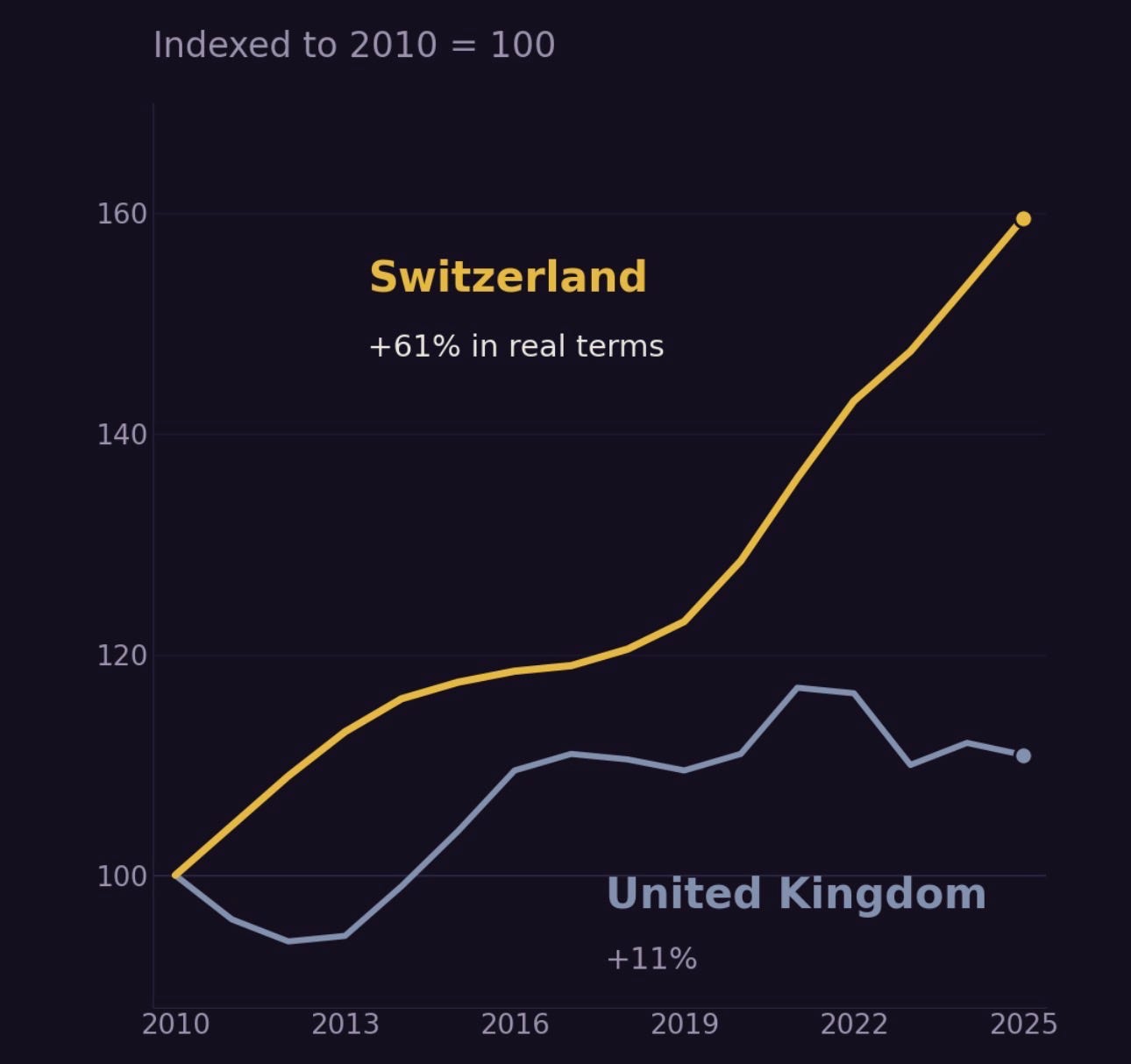
The boom is not in question. What is missing is its aftermath. The same configuration produced a price surge larger than Britain’s and none of the wreckage that followed Britain’s. The loop that ran away everywhere else did not run away here. The first thing to understand is why it did not. The second, and the harder one, is why that is not the same as being well.
III. The brakes, and what they cannot explain
The reason the loop did not run away is that Switzerland built the heaviest set of brakes any rich country applies to its housing market, and it built them deliberately, in response to exactly the danger the configuration poses.
The logic is worth seeing clearly, because it is the part Switzerland genuinely earns. Supply elasticity is the gain on the system, it governs how much of any fresh demand turns into houses and how much turns into price. Where supply is elastic, a surge of money is met by construction and the price barely stirs. Where it is inelastic, the same surge has nowhere to go but into the price of the houses that already exist. Switzerland’s elasticity sits at the floor, so almost any demand it admits becomes price almost immediately. A country in that position, if it wants to stay off the critical list, has to suppress demand and credit far harder than a country that can build. Worse elasticity demands bigger brakes, cheaper credit demands a higher stress rate. The heavy Swiss machinery is not national caution for its own sake. It is a control system calibrated to an extreme input.
So the brakes are matched to the configuration. Lenders must test affordability not at the 1.5 percent a borrower would pay but at a punitive five, so every mortgage has to survive a storm that has not arrived. Buyers must put down a fifth, and may not raise more than half of it from a pension, in a market where a deposit on an apartment in some cantons can be two years gross wages alone. Rents are pinned to a national reference rate so they cannot chase prices, a mechanism the next section examines in full. And foreign buyers, the loosest and most speculative money, are barred from the housing stock by statute. Of the three things that turn housing into a rentier sink, the supply constraint, the credit channel and the tax treatment, it is credit advanced against rising collateral that does the decisive damage, and it is precisely that channel the Swiss brakes disable. Germany disables the same channel by other means and reaches the same calm. The constraint on its own is survivable, the constraint wired to a live credit loop is not, and Switzerland cut the wire.
This is a real achievement and it is the honest core of any case that Switzerland did something right. But notice exactly what it buys, because it is less than it appears. The brakes prevent the cascade. They stop the fast, visible, self-feeding collapse, the crash. They are the answer to “why no British-style implosion.” They are not an answer to anything else. Containing a price spiral does not, by itself, make an economy productive, or keep wages tied to output, or stop a population pouring its savings into land. Those are different questions, and the brakes do not touch them. So the puzzle from the first page is only half-solved. We know why the patient did not crash. We still do not know why the patient looks well. For that, you have to stop looking for the symptoms in the obvious place, the price of houses, and start looking where they actually surfaced, which is everywhere the brakes do not reach.
IV. The capital glut
Start with the symptom hiding inside the figure everyone admires, Swiss productivity. The productivity numbers are the headline proof that Switzerland is thriving rather than merely un-crashed. Look at how they are built and the proof dissolves.
Over the three decades to 2024, Swiss labour productivity, output per hour worked, rose about 40 percent. That is the enviable number. But total factor productivity, the part that measures genuine efficiency rather than sheer accumulation, rose only 17. And real wages rose 13. Set the three on one axis and the story is not the one the headline tells.
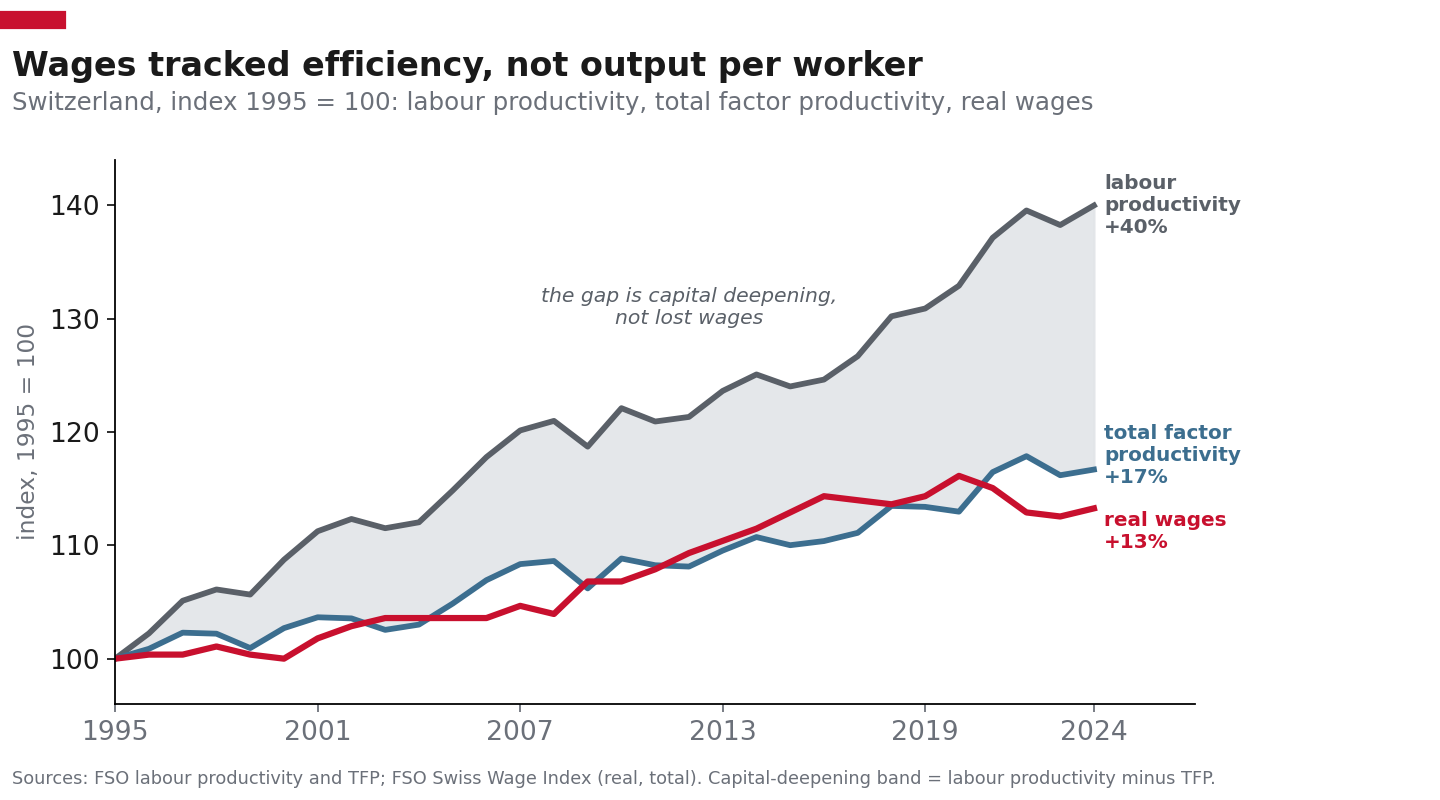
Two things follow, and they overturn the obvious reading in opposite directions. First, wages did not come loose from what workers produced. They tracked total factor productivity almost exactly, lagging it by about three points across thirty years, which is to say the labour share of income held roughly constant, around 65 percent. This is not a story of Swiss workers robbed of their output. By the measure that matters, genuine efficiency, they were paid about what they made. Second, and this is where the headline breaks, output per hour ran 27 points ahead of both efficiency and pay, and that gap is not productivity in any sense a worker shares. It is capital deepening. It is the simple fact that each Swiss working hour now has far more capital standing behind it than it did in 1995.
How much more is the part that should give pause. Run the growth accounting and capital per hour rose by something like two-thirds. And the return on all that capital fell as it piled up.
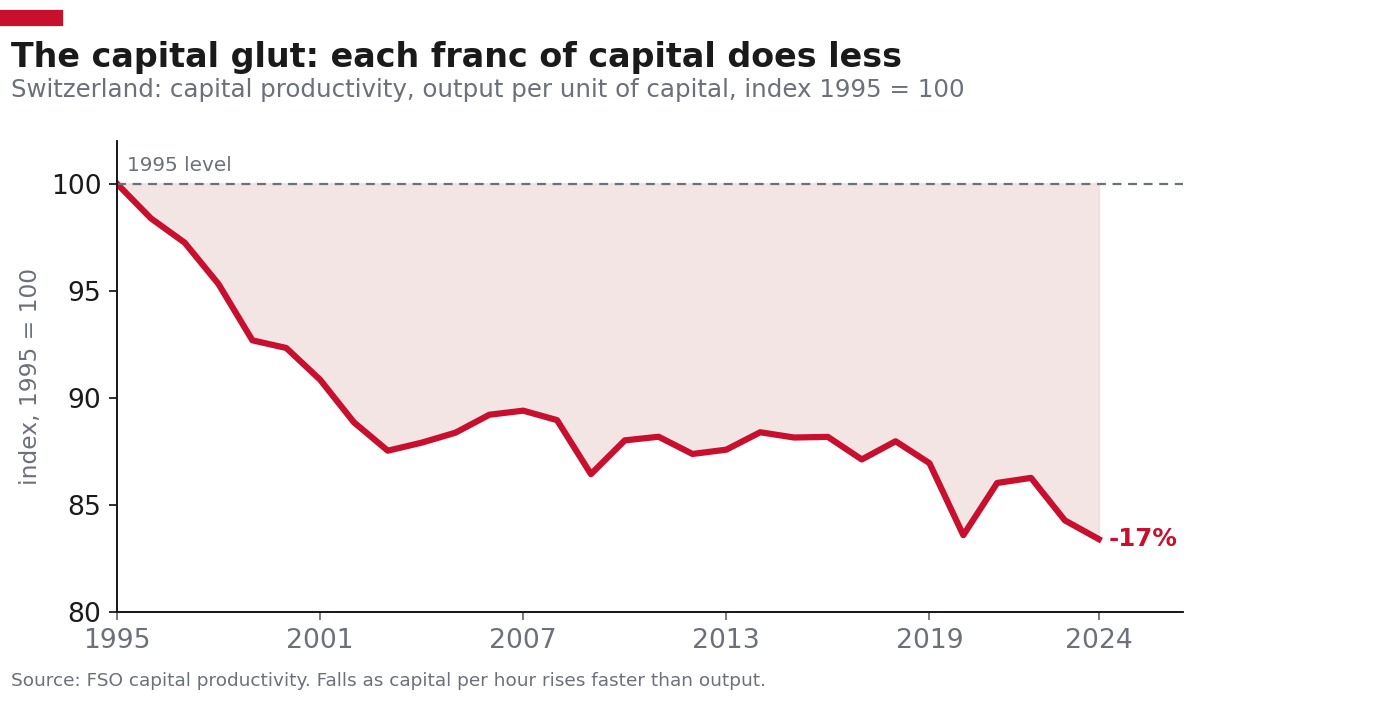
Capital productivity, the output wrung from each unit of capital, declined about 17 percent. That is the signature of a glut. Switzerland did not get 40 percent more efficient. It got 40 percent more capital-intensive and 17 percent more efficient, and the wage followed the 17. The economy substituted cheap, abundant capital for expensive, immigration-constrained labour, and it did so well past the point of useful return, until each new franc of machinery and plant produced less than the last. The productivity that looks like health is, in large part, a mountain of capital with diminishing returns sitting behind a constant labour share.
This is the first fingerprint, and it is the same disease as Britain’s wearing different clothes. The rentier black hole is, at bottom, what happens when credit is too cheap and pours into the favoured asset until that asset’s marginal return sags. In Britain the favoured asset is land, and the sag shows up as a stagnant economy behind rising house prices. In Switzerland, as the next sections explain, the cheap credit is walled out of land and routed into corporate capital instead, so the over-accumulation lands in plant, equipment and intellectual property, and the sag shows up as falling capital productivity behind a calm labour share. Less destructive, because capital at least makes something. The same mechanism all the same, cheap money over-buying the favoured asset until it chokes on it. The glut is the rentier dynamic, relocated from the housing market to the balance sheet of Swiss industry.
V. The severed channel
The capital glut explains the symptom hidden inside the productivity figure. It does not explain why the other obvious symptom, the asset-price boom itself, leaves no mark on the national accounts. A boom that large should show up somewhere in measured output. It does not, and the reason is a second piece of Swiss machinery, one written into tenancy law.
National accounts record housing as a flow of rent, not as a stock of capital gains. The Swiss boom lived almost entirely in capital gains, and capital gains are invisible to GDP. They are invisible twice over here, because Swiss rents stayed nearly flat while prices ran away above them.
That flatness is written into law. Swiss rents are tied not to house prices but to a federal benchmark, the mortgage reference rate: a single nationwide figure, published quarterly by the Federal Housing Office, derived from the volume-weighted average interest cost of every mortgage in the country. The link runs through tenancy law. Under the tenancy ordinance, the VMWG, a quarter-point rise in the reference rate entitles a landlord to raise the rent by up to three percent, and a quarter-point fall entitles the tenant to claim very nearly the same back. Rising house prices, conspicuously, appear nowhere in that formula. A landlord may still pass through a share of consumer inflation and the cost of genuine renovation, so rents are not frozen; what they are is unhooked from the price of the asset and rehooked to the cost of the credit behind it. One of the principal channels through which a housing boom turns into a rising stream of income, the channel running from asset prices to rents to the next round of credit, is cut by ordinance. And there is a quiet irony folded inside it. Because rents follow mortgage costs rather than prices, the same near-zero policy rate that should be feeding the boom is, through this one rule, holding its rental echo down, the reference rate has spent the boom years falling, which means the law has pushed existing rents not merely flat but, on request, downward.
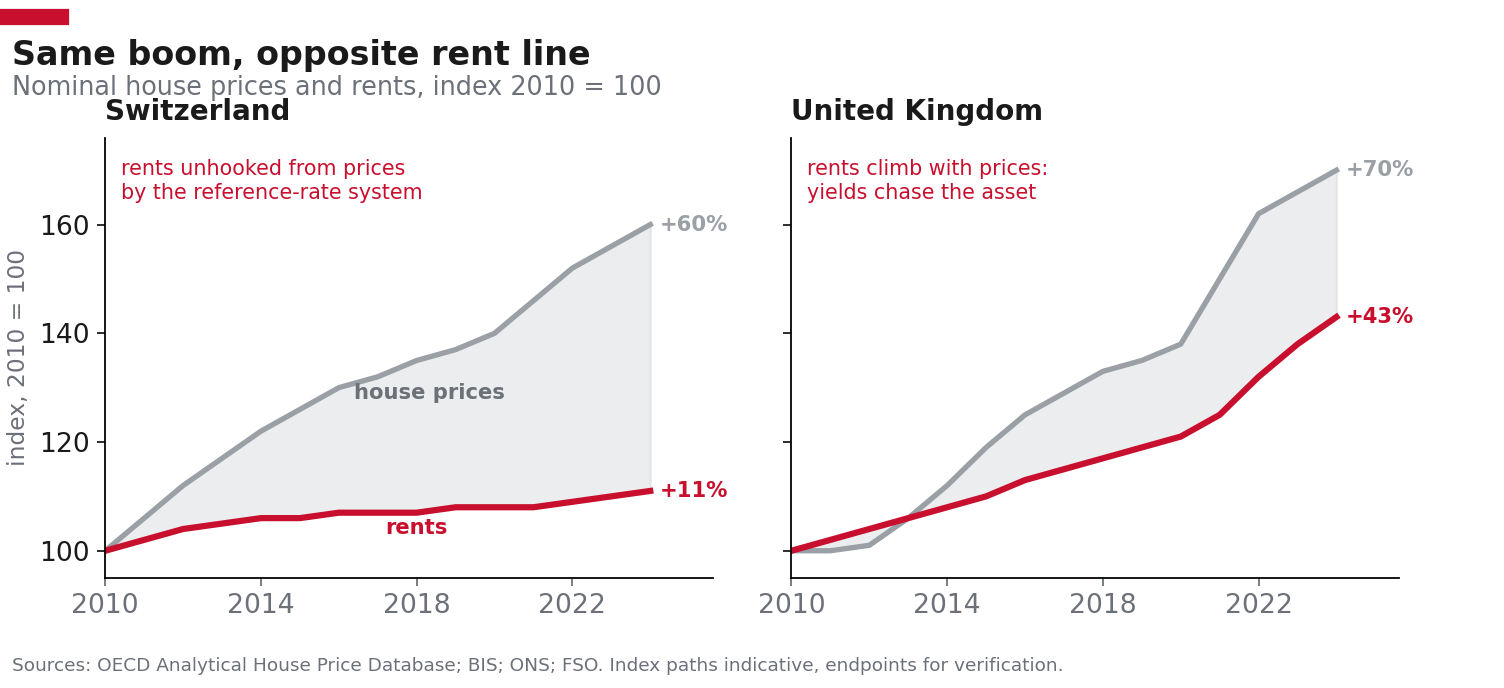
So the imputed-rent share of the economy barely grew, and the boom simply never showed up in measured output. Set Britain beside this one more time, British rents rose along with British prices, so the imputed-rent share of British output swelled, and the same housing boom that stayed statistically silent in Switzerland inflated the measured economy in Britain. Same boom, opposite footprint, decided by what rents were allowed to do. The fingerprint was never absent. It was suppressed, by a deliberate and elegant piece of law, into a part of the ledger that the figures do not count.
Two symptoms, then, both real, both disguised, the productivity that is mostly a capital glut, and the price boom that hides in uncounted capital gains. Which leaves the largest question still open. The brakes stopped the crash. The disguises hide the symptoms. But disguise is not cure, and a capital glut is not free. Something paid for all that cheap capital. The next section is where the money comes from, and it is not Switzerland.
VI. The money with nowhere to go
A glut of capital this size needs a source, and an economy that walls the world’s hottest money out of its housing stock ought, by rights, to be starved of capital, not drowning in it. Switzerland is drowning in it. It is not a Swiss policy. It is a Swiss inheritance.
The franc is one of the world’s safe havens. In every crisis, money runs toward it, and that money wants Swiss exposure. The most natural Swiss exposure, the one foreign capital reaches for everywhere else, is property, and in Switzerland that door is barred by statute. So the safe-haven flood, denied the asset it would ordinarily flow into, goes where it still can: into Swiss-franc bonds and Swiss equities. The wall that keeps it out of housing does not turn it away. It redirects it, into the financing of Swiss companies.
The central bank itself shows where that leaves Swiss borrowers.
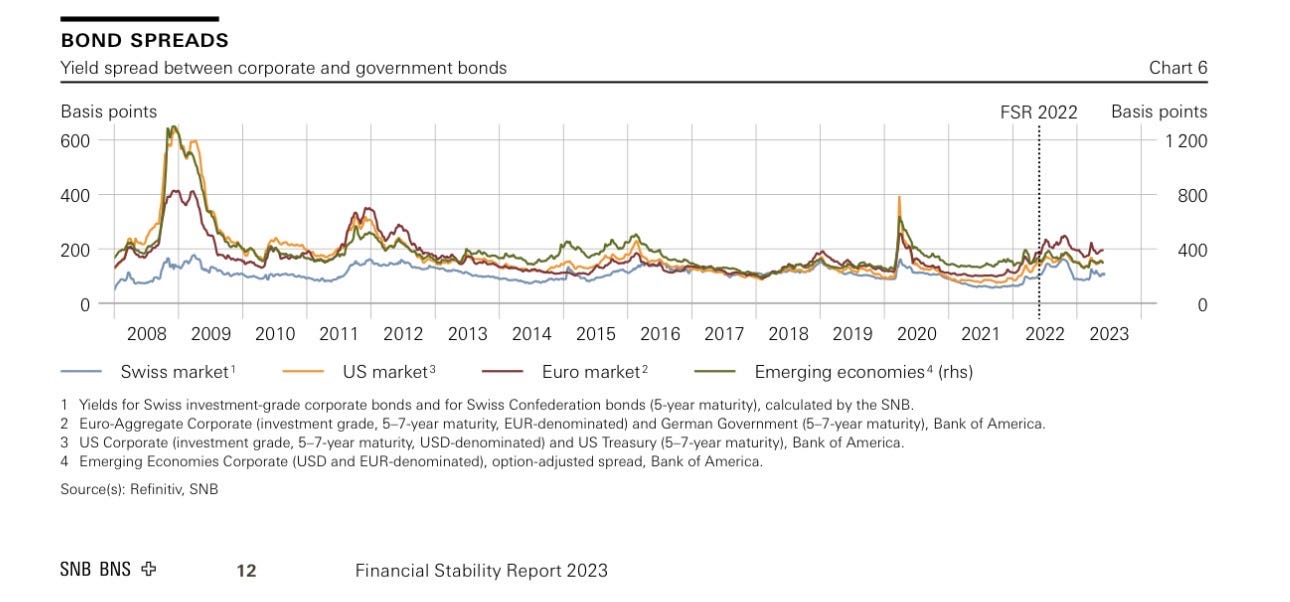
In its Financial Stability Report the bank publishes the spread between corporate and government bonds across the major markets, and the Swiss line sits stubbornly below the others, below the United States and below the euro area, across the whole span from 2008 to the present. Swiss companies borrow at a thinner premium over their own government than companies almost anywhere else, and the premium sits on top of a government rate that the same safe-haven demand has bid toward zero, so Swiss firms fund cheaply twice over, once on the base and once on the spread. That cheap funding is what built the capital deepening of the last section. The flood the country could not put into housing, it put into machines.
This specific spread will be my next empirical study to determine the effect and its size. The routing channel is real but not unlimited, the sovereign bond market is kept small by the debt brake, and the central bank itself absorbs much of the inflow through intervention, so the claim is relative to the British counterfactual, not total.
This is not something Switzerland did. The country did not legislate the franc into a safe haven, it inherited the status, from history, from neutrality, from a century of accumulated trust it draws on without replenishing. The brakes are Swiss work. The flood is yesterdays work and today’s luck. And the flood is doing the load-bearing work that the brakes get the credit for.
VII. Life support
The brakes stopped the crash. But the brakes do not explain why Switzerland looks healthy rather than merely ‘uncrashed’, they explain the absence of a symptom, not the presence of vitality. What supplies the vitality, the productive industry, the cheap capital, the absence of the capital-starvation that should follow from walling off the world’s money, is the safe-haven flood. It was never the brakes that made the patient look well. It was the flow. The brakes keep the heart from arresting, the external money does the breathing.
A patient on a ventilator presents with normal oxygen, steady colour, a reassuring monitor. None of it is recovery. It is a machine doing the work the body cannot, and the readings are only as durable as the machine. Switzerland’s monitor reads beautifully: high incomes, low unemployment, enviable output per hour, a calm housing market. The readings are produced, in large part, by an external apparatus the country neither built nor controls, pumping cheap capital into an economy whose own configuration would otherwise be gasping.
Swiss pharmaceuticals and precision manufacturing are genuinely productive, genuinely world-class. But they were financed on a subsidy, and the subsidy was over-drawn. Cheap capital with no natural stopping point does not allocate itself with discipline, it accumulates until it chokes, which is precisely the falling capital productivity of section four. The flood that looked like a blessing built a glut. So the bent gravity, the redirection of the rentier flood from land into industry, is real, but it is not the triumph it first appears. It is a crutch the country lucked into and then leaned on past the point of health.
The savings that flee into the franc were saved by people elsewhere, the cheap capital that finances Swiss industry is the parked anxiety of savers the world over, looking for somewhere safe in someone else’s crisis. Switzerland is not healthy because it is virtuous and it is not even healthy in the ordinary sense. It is a structurally sick economy holding the receiving end of a windfall, of recent strict fiscal discipline layered thinly over centuries of stability and neutrality. Competent at the brakes, lucky in the lungs it inherited.
VIII. No escape at home
There is one place the windfall does not reach, and it is the place that gives the game away. Abroad, the flood was bent into productive capital. At home, where there was no flood to redirect and no statute walling savings away from land, the Swiss did exactly what the configuration predicts. They poured their money into property.
Look at the household balance sheet. In 2000, real estate was 38 percent of household assets. By 2020 it was 43.7, the single largest holding and still climbing. On its own that proves little, property appreciated, so its share would swell anyway. The composition underneath it is the proof. Over the same two decades, directly held shares fell from 11.3 percent of assets to 7.0, and directly held debt securities collapsed from 5.5 to 1.6. Direct holdings of productive financial claims roughly halved as a share of the portfolio, straight through one of the longest equity bull markets in history. Swiss households did not ride that boom in productive capital. They tilted further into land while it ran.
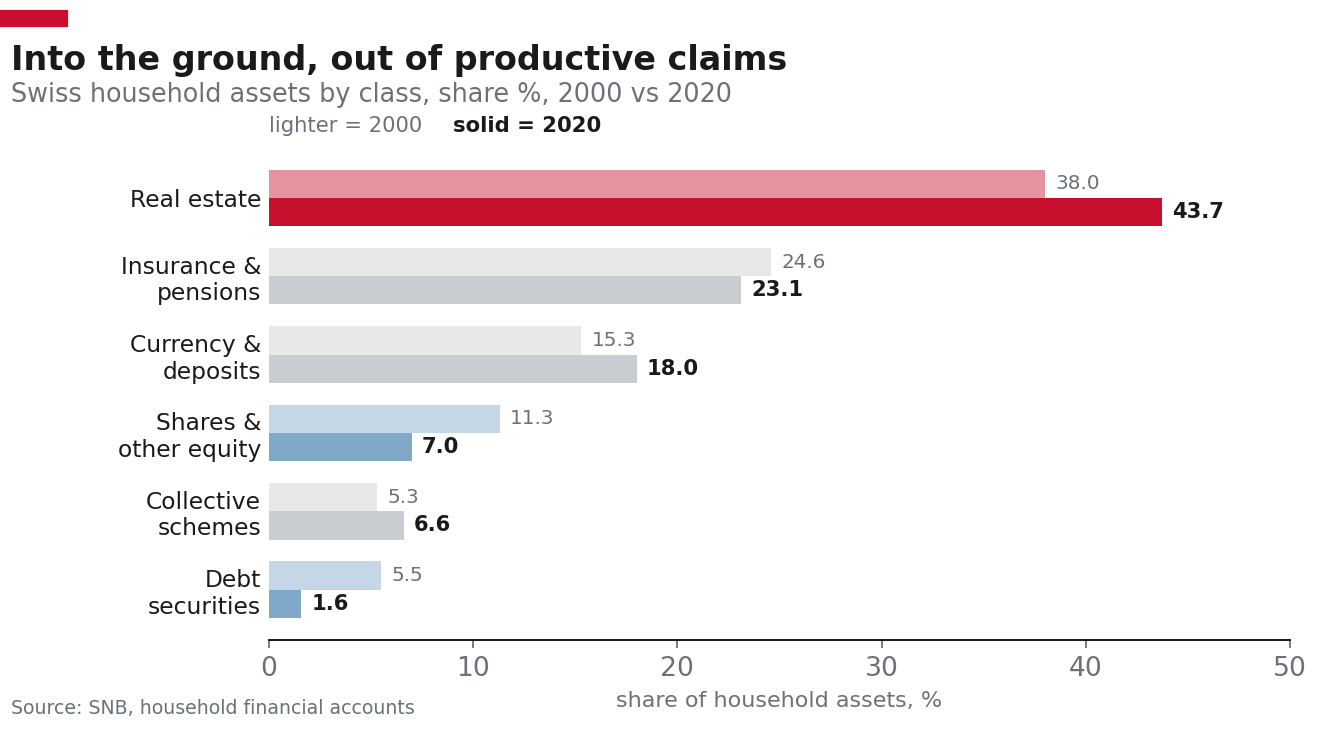
And the true tilt is worse than the headline, because part of it is hidden in the one sleeve that looks prudent. The balance sheet shows 23 percent held in insurance and pension schemes, the diversified, professionally managed portion. Look through it, and the professionals are making the same bet. Swiss pension funds hold around a quarter of their assets in real estate, and that real estate is roughly 90 percent domestic, foreign property is barely two percent of the entire pension portfolio. The pension wrapper is not a hedge against the household’s exposure to Swiss housing. It is that exposure again, in an institutional coat. Add the Swiss property funds tucked inside the household’s other holdings, and the real exposure of the Swiss household to Swiss real estate is not 44 percent. It is approaching half.
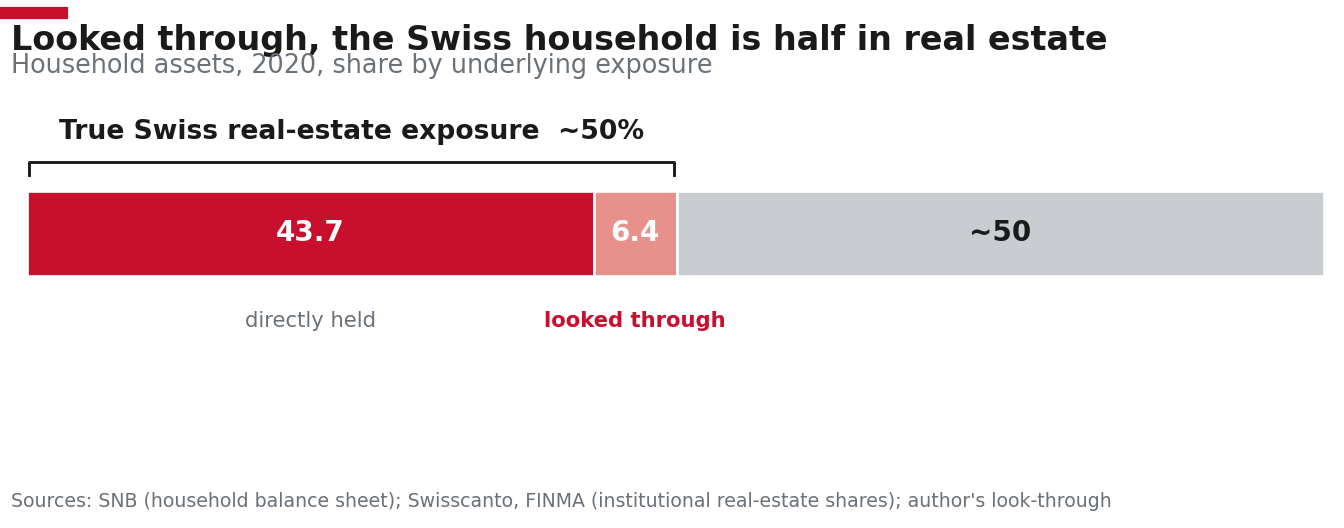
This is the rentier black hole, undisguised, with no windfall standing in front of it. About half the household balance sheet, all-in, committed to a single domestic asset, a concentration that is, if anything, worse than Britain’s. The valve that bends the foreign gravity into industry does nothing to the domestic kind, money saved at home rolls downhill into land, even inside the pension system, with every brake bolted on. And the brakes make it worse, not better, in the only way that counts here. Because renters are protected by the reference-rate system, the supply failure never becomes a felt crisis, the price of property only ever climbs and never crashes, and so loading more of the balance sheet into it remains the rational thing for every household and every pension fund to do, year after year. The cushion that contains the cascade is the same cushion that makes the slow concentration feel safe. Switzerland did not escape the black hole. Abroad it disguised it, at home it simply lived inside it, more deeply than the country it is usually held up against.
IX. When the machine is unplugged
Begin with what cannot be borrowed. The instinct, looking at a calm Swiss market from a country that has none, is to copy the policy. But the part of Switzerland that is policy, the brakes, is not the part doing the breathing, and the part doing the breathing is not policy. The ventilator is the franc’s safe-haven status, and a safe haven cannot be legislated. A ban on foreign buyers in a currency nobody is fleeing toward simply turns demand away, the same ban in a reserve-grade haven redirects a global flood into a country’s corporate sector. Britain can copy the stress test and the reference-rate rents and the foreign-buyer ban tomorrow, and it will redirect nothing, because there is no flood arriving to redirect. What makes the Swiss machine work is precisely the thing no parliament can vote itself.
There is, for completeness, one lever Switzerland’s own situation leaves open, and it is the one it will not pull. Of the three primitives, it neutralised credit and managed tax. The single brake it never touched is supply, the elasticity left at the global floor. The entire domestic policy recommendation reduces to one line. Build.
loosen the elasticity, let the cores grow upward. And it is exactly the reform the system has anaesthetised itself against, because the rent cushion means the supply failure never produces the crisis that would force the building. The country is not failing to fix its one fixable flaw out of incompetence. It is failing because it is comfortable enough not to have to, and the discomfort that would change that has been regulated away.
Which leaves the diagnosis whole, and the prognosis with it. Switzerland has the most rentier-prone structure in the developed world and the least rentier-looking outcome, and the gap between the two is made of brakes the country built and a subsidy it mostly inherited. Strip the subsidy and the brakes are not nearly enough, what remains is the worst supply elasticity on earth, a banking system fat with mortgages, a tax code that rewards permanent leverage into land, a productive sector resting on a capital glut with falling returns, and a population with half its wealth committed to property. It is Britain, with mountains and a better safety rail. The genuine efficiency underneath all of it, total factor productivity, has grown at roughly half a percent a year, the same quiet drag that sits under every rentier economy, the headline productivity that hides it is the glut, and the glut was bought on borrowed lungs.
The franc’s privilege is not a law of nature. Safe-haven status is a stock of accumulated trust over decades of strict policy and centuries of neutrality and stability, drawn down and not obviously replenished, and the one certainty about exorbitant privileges is that the country enjoying one always assumes it is permanent. When the flow ebbs, and someday it will ebb, the brakes will still be there, and they will still do their job, which is to prevent a crash. They will do nothing about the supply, the leverage, the glut or the half a balance sheet in land, because they were never built to. Britain is what this configuration looks like with the machine switched off from the start, the same disease, running without anaesthetic, in plain and painful view. Switzerland is what it looks like with the machine on, and the most expensive mistake a country in the same condition could make is to read the monitor, see the steady numbers, and conclude that the patient is well.
Switzerland is a rotten corpse full of funny money, which attracts parasites from over the world, with a population sedated by fake beliefs and distractions.
After the collapse, it might get back to its traditional values which helped it become rich, but there will be years of internal conflict and hatred.
This makes me think one is better off not buying in Switzerland or am I missing the point?