
A Plan to Fix Britain
Thirteen policies, one structural argument, and why the economics has been solved for 150 years. The problem is entirely political.

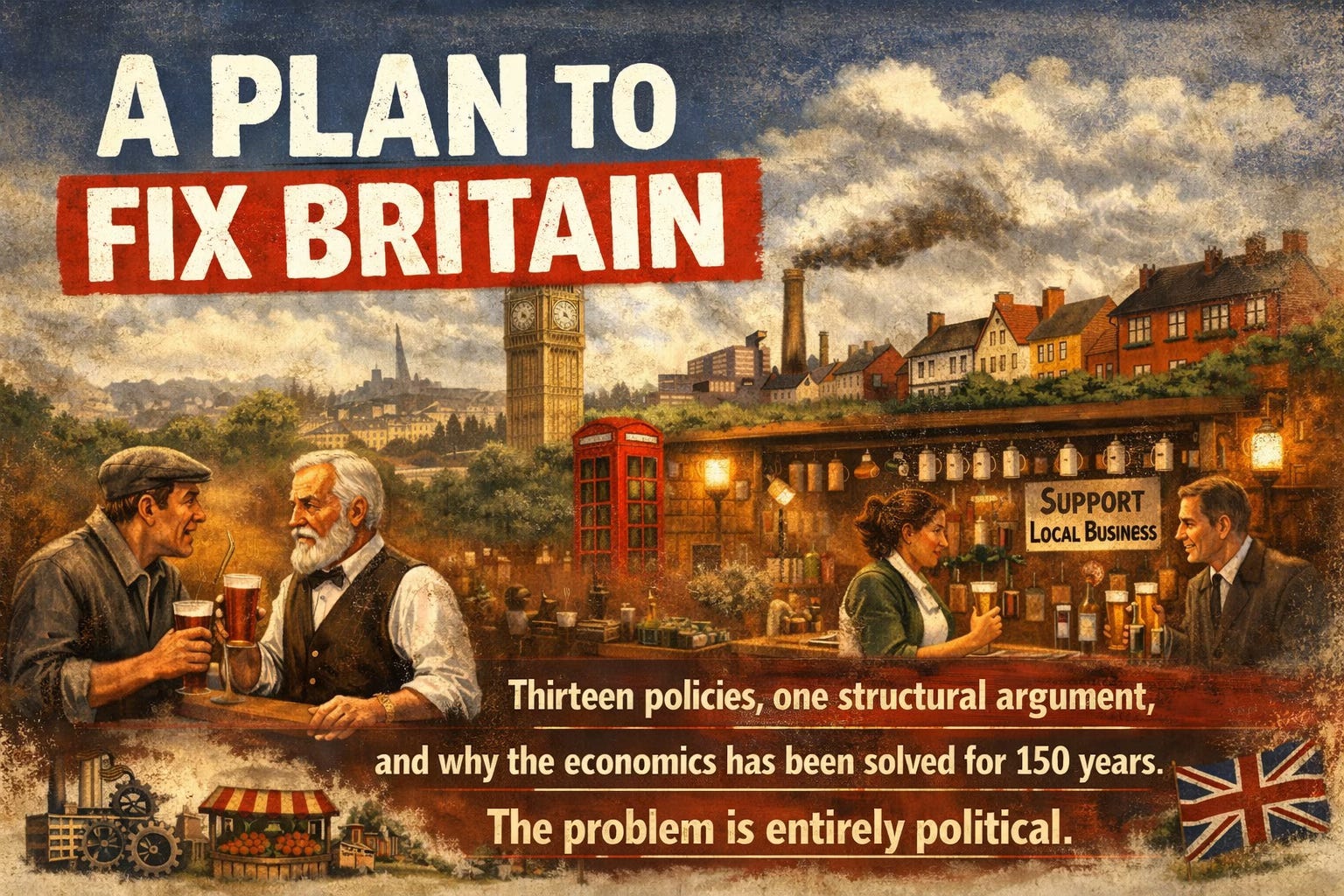
There is a version of Britain most people over forty can still remember, and most people under thirty have only heard about. It is not a fantasy. The streets were not paved with gold, the summers were not warmer, and the football was not better. But the basic arithmetic of life worked differently. You could finish an apprenticeship and afford a flat. You could work in a factory town and own a house. You could open a shop on a high street and, if you worked hard and were reasonably competent, make a living from it. The pub on the corner was full on a Friday. The local cafe had been there for thirty years and would probably be there for thirty more.
That version of Britain did not disappear because of bad luck. It was not outcompeted by history. It was systematically dismantled by a set of policy choices that concentrated the returns from economic life into an ever-narrowing group of asset holders, redirected the savings of an entire nation into residential property rather than productive enterprise, and left the generation now entering its thirties to service the debts and rents of a system built to extract from them.
This is a plan to fix it.
It is not a political manifesto in the conventional sense. It makes no promises it cannot keep. It costs what it costs, and it says so upfront, with the numbers. It describes what happens to your bills in five years, your taxes in ten, and the country’s economic position in a generation. It tells you who loses, not just who wins. And it ends, because it has to, in a pub.
Part One: How We Got Here
The British economy has a structural problem that sits beneath every other problem. It is not a problem of motivation, or culture, or the British character. It is a problem of incentives: specifically, of what the system rewards and what it penalises.
Since approximately 1997, the system has rewarded one activity above all others: owning residential property. Not improving it, not developing it, not using it productively. Simply holding it. A landlord who bought a two-bedroom flat in Bristol in 2000 and did nothing with it for twenty-five years has generated a return that no entrepreneur, no engineer, no doctor, and no skilled tradesperson could match through the exercise of their abilities. The return came not from anything the landlord did, but from planning restrictions that prevented supply from meeting demand, from mortgage lending rules that pumped credit into house prices, from tax rules that exempted property gains while taxing productive income, and from the simple fact that land in a growing city is worth more each year because the city is growing.
This would be merely unfair if it stopped there. But it does not stop there. When the most rational thing a person with savings can do is buy a second property, the savings that might have funded a new factory, a new company, or a new technology go instead into a house that already exists. The UK currently allocates approximately twice as much capital to residential property transactions as to business investment. The productive economy is not being starved of capital because there is no capital. The country is awash with it. The capital is going to the wrong place, because the incentive structure points it there.
The consequences compound. Workers who cannot afford to buy or rent affordably in productive cities cannot move to where the best work is. Wages stagnate not because employers are withholding productivity gains, but because housing costs absorb them before they can improve living standards. The ONS measures this as productivity growth, but the real wage, what you can actually do with your income, has been flatlining for two decades. Meanwhile, the GDP figures are partially inflated by a statistical convention called imputed rent, which attributes a notional rental income to every owner-occupied home. This convention added value to the UK economy even during the COVID lockdowns of 2020, when the actual economy had largely stopped functioning. The thermometer we use to measure the fever is warmed by the fever itself.
The people who could fix this are, in many cases, the people for whom the current system works. Eighty-five MPs own 184 properties between them, at a rate three times the population average. The Treasury collects £11.6 billion annually in stamp duty and £8.2 billion in inheritance tax, both of which depend on house prices remaining high. The banks hold mortgage books worth £1.7 trillion, collateralised against property values. The upper chamber that can slow or block legislation is one of the largest concentrations of inherited landed wealth in the country, and has twice in modern history killed land value taxation when it was within reach.
None of this is conspiracy. It is incentive alignment. Institutions do not reform themselves. The question is whether the external pressure, from demographics, from political movements, from the accumulating weight of evidence, eventually forces a reckoning. This plan assumes it can, and describes what that reckoning should look like.
Part Two: The Thirteen Policies
There is a hard design constraint running through everything that follows. No policy may cause a sudden, disorderly decline in property prices of a magnitude that impairs bank credit quality or triggers systemic insolvency. The mortgage book is too large. A credit crunch on day one destroys the political will for reform before it can take effect, and makes every landlord’s worst-case prediction come true. All thirteen policies are designed for an orderly, gradual transition. This is not a concession to vested interests. It is the engineering specification for a reform that survives contact with reality.
On Housing and Land
Land Value Tax
A charge of 2.5% annually on the land value of investment properties: second homes, buy-to-let portfolios, undeveloped land banks. The primary residence of every homeowner is entirely exempt. LVT is the most efficient tax in the economist’s toolkit because you cannot reduce the supply of land; taxing it does not reduce it. It suppresses speculative holding, forces productive use, and generates revenue that is ringfenced for government housebuilding until the supply-demand ratio stabilises. Advocated by Adam Smith in 1776, by Ricardo, by Mill, by Henry George, and by every serious independent review of UK housing since the Barker Review of 2004. The economics is not in dispute. The politics is.
The LVT includes explicit anti-avoidance provisions targeting living trusts and dynastic holding structures. Large hereditary landowners currently use these vehicles to pay periodic charges rather than annual taxes on their land value. Under this programme, the LVT attaches to the beneficial owner of the land, not the legal vehicle. The largest landowners in England pay the same rate as the smallest buy-to-let landlord.
The Rental Capitalisation Method and the Sound Toll Principle.
The standard objection to LVT is administrative: valuing land separately from the building on top of it requires a national valuation exercise the Valuation Office Agency has not conducted at scale. This programme resolves that objection through a mechanism that requires no new infrastructure whatsoever.
Land value and rental income are directly correlated; high-value locations command high rents. Instead of valuing the land separately, we capitalise the existing rental income stream, which landlords already declare to HMRC, at a progressive multiplier. The multiplier bands are steep and apply to the entire rental income, not just the marginal pound. This creates a critical anti-passthrough property. A landlord who raises rent to cover their LVT bill crosses a band threshold that reprices their entire rental income at a higher multiplier, producing an LVT increase larger than the rent increase. Raising rent to cover the tax makes the tax worse. It is self-defeating by mathematical construction.
The anti-avoidance mechanism draws on a principle from the Danish Sound Toll of the sixteenth century. Denmark charged ships a toll based on the declared value of their cargo and reserved the right to purchase the entire cargo at that declared value. Merchants who undervalued faced compulsory purchase at their own fiction. Applied here: if a landlord declares a below-floor rent to a friend, a family member, or a shell company in order to reduce their LVT liability, the state acquires the right to purchase the property at the capitalised value derived from that declared rent. A landlord who declares one pound per year in rent to eliminate their tax bill creates a compulsory purchase right at the capitalised value of that one pound. They would lose a £400,000 property for eighteen pounds. The right need never be exercised. Its existence makes the attempt irrational.
Two automatic guardrails bracket declared rents into an honest range: a floor at 60% of local market rate and a ceiling at 120%, both derived from the VOA’s existing quarterly rental statistics. The entire system operates from HMRC’s existing self-assessment data. No new valuation exercise required. Operative within twelve months of Royal Assent.
The Vacancy Fallback and the Punitive Escalator.
The rental capitalisation method only works while a tenant is in place. Without a separate mechanism, a landlord could simply evict their tenant to escape the calculation. This gap is closed, and closed deliberately punitively, by the Vacancy Fallback.
Every residential property in England already has a 1991 council tax band. For vacant properties, the taxable base is calculated as the 1991 band midpoint multiplied by a regional inflation multiplier derived from the ONS and Land Registry local authority house price index. A Band D property in Hackney gets a multiplier of approximately nine. A Band D property in Middlesbrough gets approximately 1.8. Geographic distortion is eliminated. The rate applied to that imputed value escalates the longer the property sits empty: standard rate for the first three months, four times the standard rate from month four, six times from year two.
A Band D property in Hackney left vacant for more than a year costs its owner £105,300 annually. That is more than six times the gross rent that property would generate. At that rate, a landlord will accept essentially any tenant at any rent. One pound a month is better than £105,300 in tax. The market clearing mechanism is the landlord’s own desperation.
This also solves the transition problem. In years one and two of the programme, new construction supply has not yet arrived. The vacancy escalator forces existing vacant stock into the rental market within months of the grace period expiring. Thousands of properties entering below market simultaneously compresses rents immediately, bridging the gap before new supply matures.
The two methods form a closed system. Tenanted properties use the rental capitalisation method. Vacant properties use the 1991 band multiplier plus the punitive escalator. A landlord cannot escape by evicting their tenant; removing the tenant moves them onto a more punitive calculation. Eviction makes the landlord’s position worse. The incentive to maintain tenancies, at any rent, is overwhelming. The only rational response to the entire system is to find a tenant, charge an honest rent, and declare it accurately.
This element is decentralised to local authorities. Councils already hold the 1991 band data, already conduct empty property inspections for council tax purposes, and already know which properties in their area are vacant. Under this programme, councils are granted the statutory power to assess and collect the Vacancy LVT directly. Revenue flows to the local authority, partially replacing council tax income. The council that enforces most aggressively collects the most revenue. Enforcer incentives are fully aligned with the policy objective.
The Bank Guarantee.
Announced on the same day as the LVT, simultaneously with the entire package. The government explicitly backstops bank credit quality on existing mortgage books through the transition period. The guarantee is almost certainly never called; its credibility prevents the crisis from materialising. Without it, the announcement effect of any price adjustment produces a credit crunch on day one. The fiscal cost of the guarantee, if partially called, is materially lower than the annual demand drag the current system inflicts on the economy. It is not generosity. It is arithmetic.
Shared Equity (replacing Help to Buy).
The government takes a 30% equity stake in new purchases. The household deposit requirement falls from approximately 20% to 5-6%. Help to Buy is repealed simultaneously; it was demand stimulus that inflated prices, the precise opposite of what was needed. The shared equity scheme breaks the deposit trap without requiring price collapse: existing mortgage holders’ equity is protected, owner-occupiers remain unthreatened, and the political coalition required to pass everything else remains intact.
Capital Gains Tax reform.
A 28% CGT on investment property appreciation, paired with zero CGT on gains from equity in productive enterprises: manufacturing, R&D, technology, infrastructure. This closes the post-tax return differential that makes landlordism more rational than enterprise. When productive capital returns permanently exceed property returns, rational capital allocation shifts. The savings trapped in deposit accumulation and buy-to-let portfolios begin flowing toward investment in things that make things.
Planning deregulation and Lex Koller.
Private building deregulation removes the supply constraint that is the root structural cause of the crisis. A new streamlined planning category for residential development on brownfield land and designated growth zones. Paired with Lex Koller, Switzerland’s model since 1983: restricting foreign property investment to prevent trade surplus recycling back into domestic prices. The affordability gains created by the other policies are preserved rather than arbitraged away.
Credit channel reform.
The Financial Policy Committee already holds these powers. No legislation required. Restrict mortgage equity withdrawal for consumption purposes; require lenders to document the purpose of MEW lending and apply higher risk weightings to consumption-purpose equity withdrawal. Tighten loan-to-value limits on investment property lending. The German Pfandbrief model is the institutional target: conservative, purpose-disciplined mortgage lending that does not use house price inflation as a mechanism for consumer credit expansion.
On Agriculture and Land
Farming deserves its own entry because LVT applied carelessly to agricultural land would bankrupt the wrong people. The design distinction is productive use versus speculative holding, the same distinction the entire programme is built on.
Active family farming is exempt from LVT. The average UK farm generates under £30,000 in profit annually while sitting on land worth millions at market value; a 2.5% charge on that market value would be immediately fatal to most farming operations. Estate land banking, large hereditary holdings with minimal productive use held primarily for capital appreciation, is liable at the full rate. Agricultural investment vehicles used as inheritance tax shelters, where institutions buy farmland under Business Property Relief without genuinely farming it, are liable and lose their APR exemption.
The post-CAP subsidy system is restructured to reward productive farming and environmental stewardship rather than acreage ownership. Larger payments per acre for smaller working farms; sharply diminishing returns at scale.
On Business Rates
Business rates raise approximately £26 billion annually, but they do it by taxing the occupation and productive improvement of commercial space. The results are perverse by design.
A busy independent cafe pays the same rates as an empty shell next door. After three months, the empty shell pays nothing. A landlord therefore has a positive incentive to keep a unit vacant rather than accept a below-market tenant, because a tenant triggers full rates liability while vacancy is eventually free. This is a direct policy-created driver of high street decay, visible in 7,000 pub closures since 2010 and the hollowing of every mid-sized British town centre.
A manufacturer who invests in new machinery and improves the productive output of their building sees their rateable value increase. The tax literally penalises productive improvement. Online retailers pay rates on cheap warehouse land in low-cost locations; high street retailers pay rates on expensive footfall locations in town centres. The tax architecture systematically advantages the channel that already has structural advantages.
The replacement is a Commercial Land Value Tax of 3-4%, assessed on land value only. Buildings, fit-out, machinery, and improvements are entirely exempt from assessment. Revenue neutral at £26 billion. The vacancy incentive disappears immediately. A landlord sitting on an empty unit pays the same as one with a tenant, so the rational response is to find a tenant at market rate. A small independent in a secondary location with low land value pays materially less than under current rates. A large retailer on prime land pays more, as it should, since prime location value is socially created, not created by the retailer.
On Labour Supply and Education
A mass housebuilding programme without a corresponding labour supply creates a different crisis: construction inflation so severe that affordability gains are offset by build costs. The education reform is structurally necessary, not peripheral.
For state-designated shortage trades, including bricklayers, electricians, plumbers, structural engineers, and quantity surveyors, education and vocational training is fully funded by the state. Zero tuition. The designation is maintained by an independent Office for Labour Market Planning, updated every two years based on vacancy rates and projected demand. The subsidy tracks need, not sentiment.
Vocational training is elevated to genuine parity with university. The T-Level programme is expanded and properly funded. Ofsted inspects vocational provision on equal terms with academic. Secondary school league tables include vocational outcomes alongside A-level results.
The ten-year horizon is not a political choice. It is a mathematical reality. School leavers making decisions now will enter the labour market in 2035, when housebuilding and green infrastructure demand will be at peak. The programme begins immediately or the construction inflation crisis arrives on schedule.
On Industrial Policy
A new British Industrial Investment Bank, modelled on Germany’s KfW, provides state-guaranteed loans at accessible rates for productive capital expenditure: machinery, factory fit-out, R&D equipment, automation. First-loss guarantees to commercial banks make lending viable where it currently is not, because banks currently prefer property-backed lending with certain collateral over productive capital lending where residual values are uncertain.
The alignment with green energy manufacturing is not accidental. The UK currently imports almost all of its wind turbines, solar panels, grid-scale battery storage, and heat pumps. A domestic supply chain for these products provides the demand certainty that justifies factory investment, reduces import dependency, and creates the manufacturing base that skilled trades graduates will enter.
On Corporate Tax
Two instruments, calibrated to each other.
A Tax Transparency Rating: a 1 to 5 score for every company with UK revenues above £10 million, based on the ratio of UK taxes paid to UK revenues over five years, displayed at point of sale and on company websites. Modelled on the food hygiene rating system. No new enforcement required; the data already exists in mandatory country-by-country reporting. The innovation is making it visible at the moment it influences behaviour.
A 10% fixed charge on intergroup IP transfers and intergroup input purchases, for companies generating over £100 million in UK revenues while reporting near-zero UK profits. This directly targets the standard profit-shifting mechanism: UK operating companies paying above-market prices to sister companies in low-tax jurisdictions, eliminating UK taxable profit. The charge applies to the gross transaction, not the net profit, so it cannot be eliminated through further transfer pricing restructuring.
On Public Utilities
Water, energy, and rail are natural monopolies. Natural monopolies with privatised profits and socialised liabilities are not capitalism. They are a specific form of state-sanctioned extraction.
Water passes to public ownership through the normal operation of corporate insolvency law. Ofwat’s 2024 determinations require the water companies to invest £96 billion over twenty-five years to achieve basic legal compliance. When this liability is honestly stated on company balance sheets, the companies are insolvent. The government acquires them out of administration at a price reflecting their actual equity value, which is zero or negative. Shareholders receive nothing beyond the genuine market value of equity in an insolvent firm. This is not expropriation. It is the normal operation of corporate insolvency law applied without political forbearance.
Energy distribution networks are acquired through the market over three to five years. Rail franchises are allowed to expire without renewal; the Department for Transport already operates LNER and Northern directly.
Part Three: What It Costs the Government
Every credible fiscal plan front-loads costs and back-loads returns. Any model that shows a surplus from day one is not credible and will not survive OBR scrutiny. Here is the honest picture.
In year one, the programme runs a net deficit of approximately £15 billion. The LVT is phased in at 0.5% while HMRC builds administrative capacity. The housebuilding programme begins at £8-12 billion. The British Industrial Investment Bank is capitalised at £5 billion. Free shortage-trade education costs £1.5-2 billion. The shared equity scheme draws £4-6 billion. The bank guarantee is a contingent liability only.
The revenue measures begin immediately. CGT reform yields approximately £4.5 billion from year one. MEW restriction adds £1 billion. Partial LVT receipts cover some of the construction costs. The transfer pricing levy becomes operative in year two.
By year three, the programme reaches breakeven. LVT at 2.0%, the intergroup levy fully operative, acquisition costs declining. A modest surplus of approximately £2 billion.
By year five, the surplus reaches approximately £18 billion annually. LVT at full 2.5% generates £37-43 billion. The transfer pricing levy yields £7 billion at steady state. Water operational surpluses begin accruing. Steady-state costs run at £13-16 billion.
By year ten, the annual net surplus reaches approximately £38 billion. Full utility surpluses. Housebuilding at maintenance phase. The green manufacturing supply chain beginning to show in the trade balance.
The year one and two deficits are real and must be financed. The UK’s current structural deficit is approximately £80 billion. Adding £15 billion in year one for a programme that returns to surplus in year three and generates £38 billion by year ten is a credible fiscal consolidation path, provided the LVT revenue trajectory is established credibly.
Council Tax and Business Rates
Council tax raises approximately £40 billion annually in England. It is assessed on 1991 property values, a system so outdated that a £3 million London townhouse can pay the same rate as a £400,000 home in the same band. It is deeply regressive: the poorest households pay the highest share of income.
A portion of LVT receipts, approximately £15-20 billion, is hypothecated to local government, distributed by formula weighted to population and deprivation. The residual local funding gap is filled by a new Local Services Levy: a per-dwelling charge based on 2024 market values, with a phased five-year revaluation and income-related discounts. The average household Local Services Levy bill is approximately £700 per year, against a current average council tax of approximately £2,000. Total local authority revenue is maintained. Council tax is abolished.
Business rates are replaced by the Commercial Land Value Tax at year three, as described above. Revenue neutral at £26 billion.
Part Four: What It Means for Your Bills
Five years from now, in 2025 prices, the position by household type is as follows.
If you are a private renter
your annual bill stack falls by approximately £4,000. Rent suppresses by 17.5% as LVT raises landlord holding costs and planning deregulation increases supply, though the first two years are flat or slightly higher as supply lags the adjustment. Your council tax becomes a Local Services Levy costing £720 instead of £1,560 from year three. Your energy bill falls by 21% as distribution network profits are eliminated and domestic renewable generation reduces costs. Your rail commute costs 19% less as franchise profit margins are redirected to fares. At a median UK net wage of approximately £29,000, this is a 13.9% improvement in disposable income without any wage increase. And for the first time, a credible path to homeownership exists through the shared equity scheme.
If you are a mortgaged owner-occupier
your mortgage payment is unchanged; it is a contractual obligation and your primary residence is entirely exempt from LVT. Your council tax becomes an £800 Local Services Levy instead of £2,171. Energy and rail savings apply equally. Net improvement: approximately £2,000 annually. The honest trade-off is that your property’s rate of capital appreciation slows as the market normalises. The housing-as-pension assumption is attenuated. A primary residence growing at 2% real rather than 8% real is still an asset, and the cash savings in bills are real and immediate.
If you are an outright owner
Typically older, asset-rich, and income-constrained, the council tax reform delivers the proportionally largest benefit. A retiree on £20,000 per year including the state pension, in a Band E property paying £2,500 in council tax, sees that bill fall to approximately £900. This is a 10% real income improvement with no change to property ownership.
If you are a small landlord with one investment property
You are worse off by approximately £2,100 per year by year five. LVT on the investment property at 2.5% on imputed land value costs approximately £3,025 annually. Rent compression reduces gross income by £2,100. Your net rental income falls from approximately £5,500 to approximately £1,300. This is partially offset by the same primary residence bill savings as everyone else. The programme offers an orderly exit: you can sell into a market with buyers, and redeploy capital into productive enterprise investment with the zero CGT exemption.
Part Five: The Economic Forecast
What does Britain look like in ten to fifteen years if this works?
On the housing market, the price-to-wage ratio falls from its current level of approximately eight to twelve times average earnings depending on region, toward a range of four to six times, consistent with pre-1997 norms and with what most European economies have maintained. This is not a crash. It is a decade-long normalisation driven by supply increase, demand suppression of speculative holding, and the removal of the credit channel that has been amplifying prices. Owner-occupancy rises toward European norms, from its current 63% and falling, toward 70-75%.
On productivity, the removal of the statistical distortion from imputed rent means measured GDP falls by approximately 8-9% as the accounting fiction corrects. This is not a real decline in welfare. It is the thermometer cooling because we have stopped warming it with our hands. Real productivity, measured on what the economy actually produces, improves as capital reallocation takes effect. The UK has run a persistent productivity gap relative to Germany and France since approximately 2008. This programme closes perhaps half of that gap over a decade as the credit channel that drove divergence is reformed.
On wages, the mechanism is straightforward. When productive capital investment rises, as savings are redirected from buy-to-let portfolios toward enterprise, output per worker increases and competition for workers intensifies. Real wage growth resumes. Combined with the reduction in housing costs, the effective real standard of living improves more than either measure captures individually.
On the trade balance, the UK runs a persistent current account deficit of approximately 3-4% of GDP, driven substantially by the import of goods we no longer manufacture. Domestic green energy manufacturing reduces the energy import bill. A reformed industrial base, supported by the British Industrial Investment Bank and the skills pipeline, begins recovering export market share in engineering, advanced manufacturing, and green technology. This is a fifteen-year story, not a five-year one. But the trajectory is established by the policy choices made in the first parliamentary term.
On the public finances, the programme moves from deficit in years one and two to surplus in year three, reaching approximately £38 billion annually by year ten. The structural deficit, which currently runs at approximately £80 billion, is eliminated and inverted. The UK’s debt-to-GDP ratio begins declining in real terms for the first time since 2008.
On inequality, the Gini coefficient, which has been rising steadily as housing wealth concentrates, stabilises and then declines as the ownership rate rises, wage growth resumes, and the LVT and CGT reforms attenuate the compounding of property wealth across generations. The inheritance of landed wealth, currently the dominant driver of intergenerational inequality in Britain, is systematically taxed and gradually unwound.
None of this happens automatically or painlessly. The transition costs are real, the administrative challenges are real, and the political opposition from vested interests will be formidable. The sequencing matters enormously. The bank guarantee must be announced before anything else to prevent the crashing-the-housing-market attack line from gaining traction. The shared equity scheme delivers visible benefits to first-time buyers before the LVT costs land on landlords. The council tax replacement benefits outright owners and pensioners before the CGT reform touches their capital gains. Every policy creates the coalition that enables the next.
Part Six: The Pub
All of the above, the LVT, the industrial bank, the vocational education, the nationalised water, the commercial rates reform, the green manufacturing coalition, the fiscal model, the OBR methodology, adds up to something that can be described in one sentence.
Britain should be a country where if you work hard and are reasonably competent, the basic arithmetic of life works.
The structural reforms create the conditions. They reduce the rent burden on local businesses. They suppress the rates bills that have been closing independent shops and pubs for a decade. They reduce energy costs for every small business operating on thin margins. They make the high street viable again.
But viability is not the same as life. A building that can support a business is not the same as a business that is supported by its community.
When you spend money at a local pub or independent cafe, it recirculates locally at a rate roughly two to three times that of the same spend at a national chain. The landlord pays local staff, buys from local suppliers, calls a local tradesperson. The chain extracts margin, routes profit through a holding company, and minimises its tax contribution, which we have separately addressed. The economics of community are not sentiment. They are a measurable multiplier.
Britain built its trade union movement, its political culture, and its civic life in the pub. The institutions that gave working people power were forged in rooms above public bars. The pub is where horizontal social trust is constructed: between neighbours who would not otherwise meet, across communities that the internet has sorted into vertical silos of mutual incomprehension.
This programme cannot legislate for that. It can only create the conditions. The cultural shift, the decision to put your money where your community is, to walk to your local rather than order online, to treat the independent as the default rather than the exception, is the one part of the reform that costs nothing to implement and requires no parliamentary vote.
We are rebuilding the productive economy from the ground up. That starts with the planning system, the tax system, and the banks. But it also starts on your high street, on a Friday evening, with a pint in your hand.
The pub is not a luxury. It is infrastructure.
The closing
I am not a politician. I am a hobbyist economist and a business owner. I left my country with a thought it could never improve, the only way I would succeed is to leave, I have mostly been correct. I believe in my mathematics here, I have also mostly been correct.
The question that must be asked is, is this incompetence, or intention. Is our government so blind to see what one man with a free evening can, or do they simply wish to privately profit from our demise.
Incompetence can be fixed. Greed is harder.
While all politicians offer an ‘answer’ that is easily sold, on the basic human principles of hatred of the other, whether that be the poorest or the wealthiest, immigrants or ‘nationalist racists’.
Do you really hate them, do you really think this is the answer?
I would like to offer a reasonable alternative. We just all hate being poorer, and we take any answer that looks like it might solve it, we are angry, and that anger is easily misdirected. The misdirection is intentional, political division is profitable.
I’d like to recommend. We should all probably have this chat at the pub, we might realise what we have lost as a nation, we all have quite a lot more in common than you think, and we just might save the economy while we do it.
If this concept interests you, or you are a fan of a reasonable path, not what looks like our binary options of communist hell hole, or fascist doomsday.
I would appreciate a share.
This piece is the written companion to the Housing Theory of Everything series. The full policy document, fiscal model, and household bill projections are available in full. Sources for all figures cited, including HMRC, ONS, OBR, Ofwat, Ofgem, ORR, and the academic literature, are documented in the technical annexes.
The economics has been solved for 150 years. The problem is entirely political.
Excellent work. I would like to see a National Infrastructure Board as a permanent arm of the state, so infrastructure is not tied to the election cycle, as is the case currently.
I would like to offer a reasonable alternative. We just all hate being poorer, and we take any answer that looks like it might solve it, we are angry, and that anger is easily misdirected. The misdirection is intentional, political division is profitable.